
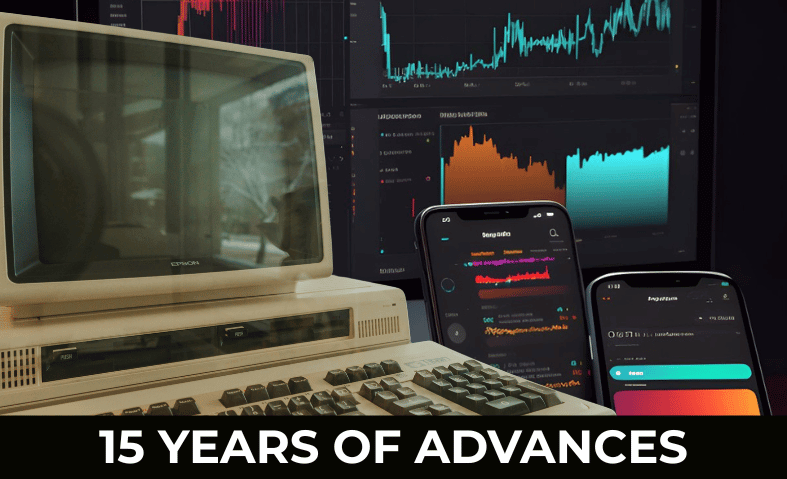
When I started writing for the FXCC blog in 2011, the trading world looked very different. My early articles covered ECN forex trading, the industry’s stranger side, and the economic releases and headlines that moved markets that week. One title, Thunderbirds Are Go! International Rescue (the IMF) are Primed and Ready to Launch, shows the sort of headlines we were working with. Let’s take a stroll down memory lane and see how forex trading has changed since I first started writing about it!

Back then, most of my writing centered on currencies and commodities. MetaTrader 4 was the platform everyone knew, and mobile trading was still a new idea to most. To fund an account, you usually made a bank transfer or used a credit card. E-wallets were starting to catch on, but they still required a lot of manual work.
Smartphones were becoming more popular, and better internet connections made it easier to follow the markets. But doing almost everything from a phone was still a long way off.
Looking back at those early articles now, what strikes me isn’t that the markets have become unrecognizable. The same currencies still react to economic data, central-bank decisions, and global events. It’s everything around them that’s changed.
The range of tradable assets has exploded, platforms have evolved, and traders have more ways than ever to access information. After 15 years of writing about the industry, these changes stand out.
1. From MT4 to the Brave New World of Trading Platforms
MT4 was the name that kept coming up when I started writing about forex in 2011. Most traders knew it, and you could do plenty with it. Still, the forums showed a different side: traders shared their own indicators and debated trading strategies, and not everyone agreed.
MT4 had pretty much everything a forex trader needed in one place. You could follow currency pairs, add your favorite indicators, and even build your own automated strategies. For most traders, it was the default starting point, but it also kept everything inside one closed environment, unlike newer options.
MT5 was introduced in 2010; however, people were not eager to switch from MT4 immediately. Many traders had already built their own systems using custom indicators and Expert Advisors coded in MQL4. MQL5 is used to develop Expert Advisors and other programs for MT5; therefore, some parts of the code had to be rewritten to run on MT5. For many traders, it wasn’t worth the trouble.
MetaQuotes last issued new MT4 licenses to brokers in 2018; however, the platform remained supported, while brokers and traders preferred not to switch to the newer version. By 2021, more brokers were using MT5, but that didn’t mean traders stopped using MT4. After all, if you have developed your indicators and Expert Advisors, there is no point in changing platforms because of updates.
Another major development was charting: TradingView provided charting tools, drawing tools, alerts, and a community where traders can exchange views. It integrated the broker’s platform, letting traders analyze and trade in one software rather than using separate programs for each.
Some traders have stuck with MT4 because they know it inside out and have no reason to change. Others have moved on, perhaps because they trade more than just forex or prefer another platform’s charting tools. There’s much more to choose from now than there was in 2011.
There isn’t one right answer for everyone, and that’s a big change from the days when MT4 was the obvious starting point.
2. The Move to Mobile Trading
Around the water cooler, the talk was all about mobile trading in early 2012, around February, if memory serves. The first real smartphone MT4 release was only on iOS, with Android following a couple of months later. I was, and still am (not on the same device, of course), an Android user, so I think I first saw MT4 on mobile around April 2012. Josh, who has always been an Apple devotee, had bragging rights for those intervening months, but I got him back. That’s a story for another post!
Seriously, this was a big thing back then. Before, a phone could only monitor the market when you weren’t sitting behind your computer. Carrying your trading platform with you was becoming increasingly realistic, but it still fell short of the desktop experience.
Of course, early versions of mobile trading apps weren’t as advanced as today’s. MetaQuotes, for example, announced its Android release while noting that it would implement technical indicators later. This shows how far the concept of mobile trading has yet to go.
Today, you can do almost everything related to trading on a phone, from monitoring charts and setting alerts to managing positions and, where applicable, creating and funding an account. The desktop platform isn’t obsolete, but it is no longer the main hub.
This also has a dark side. With constant access to prices and news, it’s tempting to do something all the time. More access doesn’t mean more effectiveness. Some decisions require no action.
3. What Happens Behind the Screen
The technology traders see is only part of the story. A platform can look much the same on the screen while the systems behind it have changed considerably.
Financial firms use specialist data centers in trading hubs, including Equinix LD4 in Slough, near London, and NY4 in Secaucus, New Jersey, in the New York area. These facilities let firms place their systems close to other parts of the trading infrastructure. The aim is to reduce delays as market data and orders move between systems. Not every broker uses these facilities, and proximity alone doesn’t guarantee better execution.
From the trader’s perspective, the key takeaway is this: traders cannot base order execution solely on the information shown on the chart. In fast-moving markets, timing becomes critical. A stop-loss order depends on market conditions and how the broker executes the trade.
Virtual private servers, or VPS hosting, have also made automated trading more practical for retail users. An Expert Advisor can run on a remote server instead of relying on a home computer being on and connected. That can help keep a strategy running, but it doesn’t eliminate software faults, server outages or trading losses.
The way we open and fund an account has changed. Paper forms and manual checks have increasingly given way to online applications, document uploads and electronic identity verification. Bank transfers and cards remain common, but e-wallets and other digital payment methods have expanded options in some markets.
When I started writing about forex, much more of this process felt separate from the trading itself. Now, many of these steps are handled online. The technology behind the screen has become part of the everyday trading experience, even if most users never see it.
4. From Currencies and Commodities to Crypto
Bitcoin had been around since 2009, but it wasn’t yet the regular subject of market commentary that it would become. The 2017 rally brought it to a much wider audience, while Ethereum, launched in 2015, became another name traders needed to understand.
Ethereum was unique. Its blockchain technology enabled smart contracts and decentralized apps; Ethereum’s story wasn’t just about the cryptocurrency’s value. This was new for people more accustomed to currencies and commodities.
As interest in crypto grew, brokers increasingly had to consider how digital assets fit into their offerings. Retail traders’ options were no longer limited to familiar currency pairs, metals, and energy products.

The crypto market also had other trading dynamics. Unlike the traditional forex market, which operates on a weekly schedule, the crypto market is available 24/7, including on weekends. Price action is more volatile because no regular central bank or economic news events guide forex market participants.
However, 24/7 availability has pros and cons. The market’s constant availability means there is no closing day. This, together with volatility, might lead to quick losses.
Regulators have responded in different ways. In the UK, the Financial Conduct Authority announced in October 2020 that it would ban the sale of certain cryptoasset derivatives and exchange-traded notes to retail consumers. The rules took effect on 6 January 2021. The decision reflected concerns about valuation, volatility and consumer risk.
For me, crypto reminds me how much the conversation around trading has changed. A subject that once sat outside the usual discussion now has its own vocabulary, market structure and regulatory questions. Traders have more choice, but they also need to understand what they’re dealing with before committing money to a market.
5. Automation, Algorithms and AI
People often talk about artificial intelligence as if it introduced automation to trading. It didn’t. Retail traders used rule-based automation long before AI became a thing.
MT4’s Expert Advisors let traders write rules to open and close trades, manage orders, and respond to market conditions. These tools followed instructions. Their results depended on the code, the data, and the assumptions behind the strategy.
What’s different now is the range of tasks AI tools can help with. They can help write code, explain technical concepts, summarise documents, and organize research. Some analytical tools also use machine learning to process data and identify patterns.
That can be useful, but helping someone analyze information isn’t the same as predicting where a market will go.
AI-generated summaries can miss context or repeat errors. A coding assistant can suggest a flawed strategy. A backtest can look impressive because of overfitting, where a strategy is tuned too closely to historical data and performs much worse in live markets. A model trained on past relationships may also struggle when conditions change. In the end, the lesson is this: use AI as a tool, not a substitute for judgment. Taken together, these changes show how trading has evolved over 15 years, from platforms and mobile access to crypto and AI. The technology has changed, but the need for judgment remains the same.
Fifteen years later, the key difference lies not only in the technology itself but in how deeply it has penetrated every aspect of the trade. It has been a long way from where I started writing about trading in 2011. The technology has changed, but the need for judgment has stayed the same.
I will never accept any claim that using artificial intelligence removes uncertainty from trading. Confidence isn’t the same as being right, and neither is backtesting.
AI may speed up research and coding, but it doesn’t take responsibility for the decision. That’s still down to the trader.
What Comes Next?
I won’t try to predict exactly what the next 15 years will bring. Technology will keep developing, and the tools available to traders will change with it. What interests me more is how people choose to use those tools.
It’s easy to assume that having more information makes trading easier. Sometimes it does. Other times, it just gives you more things to worry about. Knowing what to ignore may prove just as important as knowing what to watch.
After 15 years of writing about forex, I still come back to the same basic reality. The platforms have changed, the range of markets has widened, and the technology behind a trade is far more advanced than it was in 2011.
A phone can make trading easier to access. A platform can offer more ways to analyze a chart. An AI assistant can help organize information.
None of them can take responsibility for a trade on your behalf.
Here’s to the next fifteen years. Enjoy your trading and, as I put it back in 2011, Thunderbirds are go!
CFDs are complex instruments and carry a high risk of rapid losses due to margin trading. Consider whether you understand how CFDs work and whether you can afford the risk of losing your money. This article is for educational purposes and is not investment advice.