
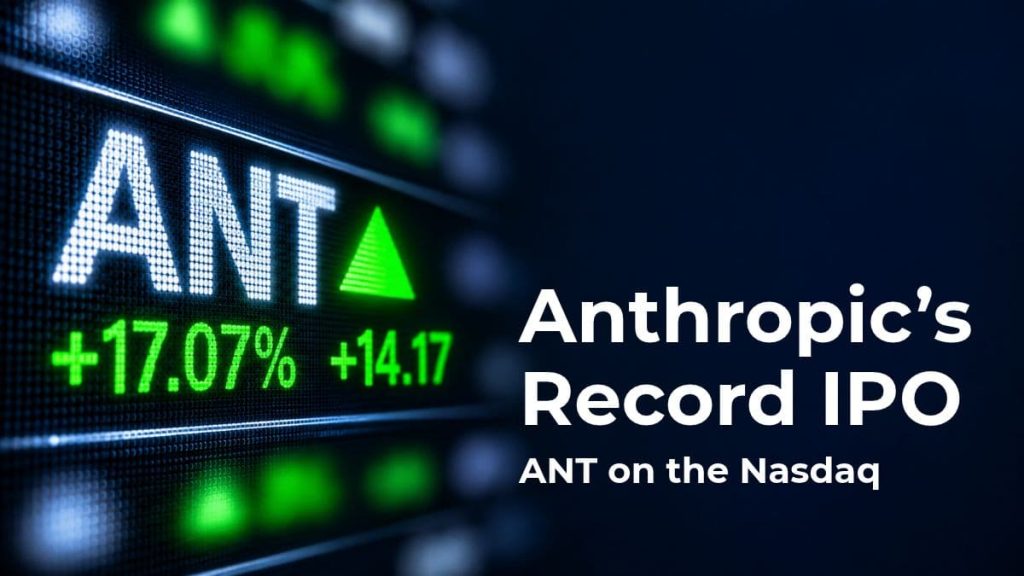
Two days ago, Anthropic was still private. On Thursday, it became one of the world’s most valuable publicly traded businesses, closing its first Nasdaq session at a fully diluted valuation of about $1.76 trillion.
The Anthropic IPO was the biggest share sale Wall Street has ever seen. Anthropic, the company behind the Claude AI models, priced its shares at $83 on Wednesday evening, comfortably above the $70 to $78 range announced a week earlier. It also increased the number of shares on offer from 825 million to around 980 million, raising $81.3 billion.
The SpaceX IPO in June raised $75 billion. That record lasted five months!
How the first day played out
Anthropic shares started trading on Thursday, 19 November, under the ticker ANT. The first trade was $111.50, 34% above the IPO price. The shares subsequently fell back during the session and finished at $97.17.
ANT finished its first session 17% above the IPO price. It was a bad day for anyone who bought the first trade at $111.50, though, as they ended up almost 13% down by the close.
SpaceX gained 19% on its first day of trading in June.
Anthropic’s valuation came to $1.27 trillion at Thursday’s closing price, based on its outstanding shares. The figure climbs to $1.76 trillion when it includes employee options and shares reserved for staff.
Interest in the IPO was already running high days before the price was set. By Sunday, orders had reached almost seven times the number of shares Anthropic intended to sell. Retail investors were allocated up to 20% of the offering.
The $26 billion side deal
$26 billion in shares were coming in alongside the IPO in a side deal. Seven technology companies agreed to buy Anthropic shares at the $83 offering price, with the private placement due to close immediately after the listing.
The amended filing, dated 10 November, named the seven buyers of these Class N shares as:
- Nvidia, $10 billion
- Google, $10 billion
- AMD, $2.5 billion
- Broadcom, Micron and Microsoft, $1 billion each
- TSMC, $500 million
These don’t come with voting rights, nor can they be traded on Nasdaq. They do, however, convert into Class A shares if sold to an unaffiliated buyer.
Anthropic has raised more than $100 billion from the two deals. Nvidia, Google, and some of the other investors are already among its suppliers, providing chips and computing capacity for its AI models. They’ve now put another $26 billion into the company.
The technology companies supplying Anthropic have skin in the game. Their sales help finance its expansion, and they now have a financial interest in how the company performs on the stock market.
What the prospectus shows
Anthropic saw revenues of $33.24 billion for the nine months to 30 September. That’s almost 13 times its revenue for the same period last year. The third quarter alone saw $17 billion come in.
The pace of growth has eased. Revenue rose 47% from Q2, after jumping 144% from the previous quarter.
Operating profit swung from $974 million in Q2 to a loss of $567 million in Q3. Anthropic attributes the reversal partly to $5 billion of computing capacity purchased through short-term contracts, which cost more than the multiyear agreements it normally seeks.
Despite the operating loss, the company reported an adjusted Q3 profit of $2.5 billion after excluding stock-based compensation, charitable contributions and other items. The adjusted margin fell to 15% from 19% in Q2.
Anthropic reported a net loss of $104 billion for the nine months. A $94.3 billion accounting charge accounted for most of it, following the revaluation of convertible notes and related instruments as the company’s valuation climbed. The charge didn’t involve any cash payment.
Anthropic has $895.4 billion in computing and infrastructure commitments, with around $70 billion due over the next 12 months. It also has $6.2 billion in existing debt.
The 93-page risk section of its prospectus covers everything from competition to financial performance. It even warns of what the company calls “catastrophic or existential risks to humanity”.
An unusual company to own
Anthropic is registered as a public benefit corporation. Its prospectus states that the company will consider the public interest alongside its financial objectives, and advises shareholders not to view their investment “in purely transactional terms”.
The Long-Term Benefit Trust has the power to elect or remove a majority of Anthropic’s board. Ordinary shareholders therefore have limited influence over the composition of the board, despite owning shares in the company.
The IPO accounted for less than six percent of Anthropic’s outstanding shares. The rest remain firmly in the hands of shareholders.
Why the Anthropic IPO timing raised eyebrows
Tech stocks were already falling when the Anthropic IPO launched , with the Nasdaq 100 down 13% from its early October peak by the time the shares were priced.
Weaker demand was the recurring theme for other technology companies that listed that autumn.
Anthropic priced above its original range and increased the size of the offering. Investors still bought in, pushing the shares well above the IPO price on Thursday despite the weaker market.
This latest listing also gives investors another way to get their feet wet with AI stocks. Some of the money going into ANT may well originate from existing technology holdings, particularly if investors decide to make room for the new arrival.
The speed of Anthropic’s rise has been striking. It was valued at $380 billion in a February funding round, then reached $965 billion after raising $65 billion in May. The company filed confidentially for its IPO on 1 June and published its prospectus in October.
Dates to watch after the Anthropic IPO
The next few weeks will see multiple events that could be significant for trading in ANT. Index inclusion is one of them.
After SpaceX’s listing, index providers changed their rules to allow very large new companies to enter major benchmarks much sooner than before.
“Anthropic is a mirror image of the SpaceX IPO,” Carsten Hesse, head of index events at Berenberg, told Reuters. He was referring to the index-related buying that helped support SpaceX during its first 15 days of trading.
The immediate dates on the calendar are:
- Friday 20 November: Direxion plans to launch two leveraged funds tracking ANT.
- Monday 23 November: Cboe plans to list options on Anthropic shares.
- 21 December: Anthropic is on track to join the Nasdaq 100.
The number of shares finding their way to the market may also increase. From the first day of trading, directors, officers, and employees other than the founders can sell up to 10% of the shares they hold under the lock-up arrangements.
The hold period lasts for 180 days, finishing around mid-May next year. Once that is over and done with, we could see a much larger supply of shares on the market, depending of course on how many eligible holders decide to sell.
At Thursday’s closing price, Anthropic’s valuation was $1.76 trillion, a whisker shy of the $1.77 trillion valuation attributed to SpaceX when it listed in June.
For now, limited supply, index-related buying, and strong initial demand are working in Anthropic’s favor. The picture will become clearer in December and January. By then, the early excitement will have settled, and investors will have a better idea of how much support the shares have without the IPO-related buying.
CFDs are complex instruments and carry a high risk of rapid losses due to margin trading. Consider whether you understand how CFDs work and whether you can afford the risk of losing your money. This article is for educational purposes and is not investment advice.