
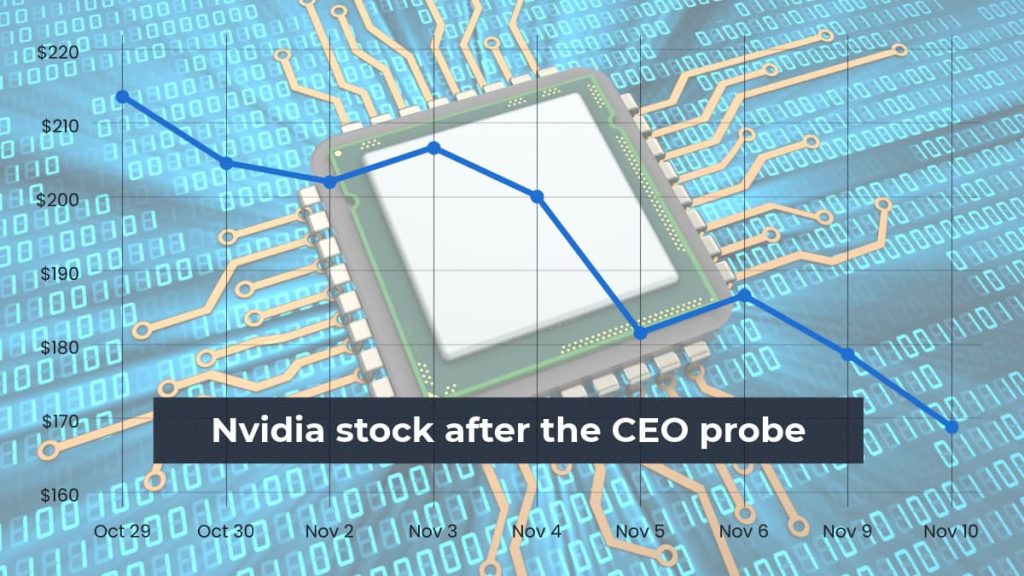
On Monday, we looked at what the board’s probe into Jensen Huang could mean for Nvidia stock. Two sessions later, the market has given its first answer. Nvidia closed at $168.89 on Tuesday, November 10. That’s 9.5% below Friday’s close of $186.64 and only 2.8% above its 52-week low of $164.27.
Go back to October 29, the last close before The New York Times first reported on Huang’s ties to Alice Huang, and the shares are down about 21%. The investigation isn’t behind all of that. The post-midterm AI sell-off did plenty of the damage on November 4 and 5. The last two sessions, though, are Nvidia’s own.
What’s changed since Monday
Monday’s fall looked like a company problem from the start. Nvidia closed 4.27% lower at $178.67 while the S&P 500 gained 2.3% and the Nasdaq rose 2.5%, according to ABC News. When one stock sinks on a day the whole market rallies, traders usually read it as stock-specific risk.
Tuesday brought a new report. The Information said Alice Huang’s network of companies in China and Singapore helped move at least $7.5 billion of Nvidia chips to Chinese firms, citing two people who know her. That’s about 240,000 H100, H200 and some A100 chips, some of them barred from sale to China. Reuters said it couldn’t independently verify the report, and nothing in it has been proven.
The shares fell another 5.47% that day. Around 427 million shares changed hands, roughly three and a half times the stock’s average volume, according to The Motley Fool’s data. The wider market was weaker too after a hot inflation reading, but the Nasdaq only slipped 0.74%, and the S&P 500 lost 0.38%.
The board also named who’ll run its review. On Tuesday, its independent members said they’d hired Joon H. Kim, a former acting US Attorney for the Southern District of New York, and his firm Wachtell, Lipton, Rosen & Katz “to conduct a thorough and independent investigation”. The statement didn’t give a timeline.
Separately, President Donald Trump said on Monday that the FBI is looking into the relationship, Reuters Breakingviews reported.
Nvidia stock price since the story broke
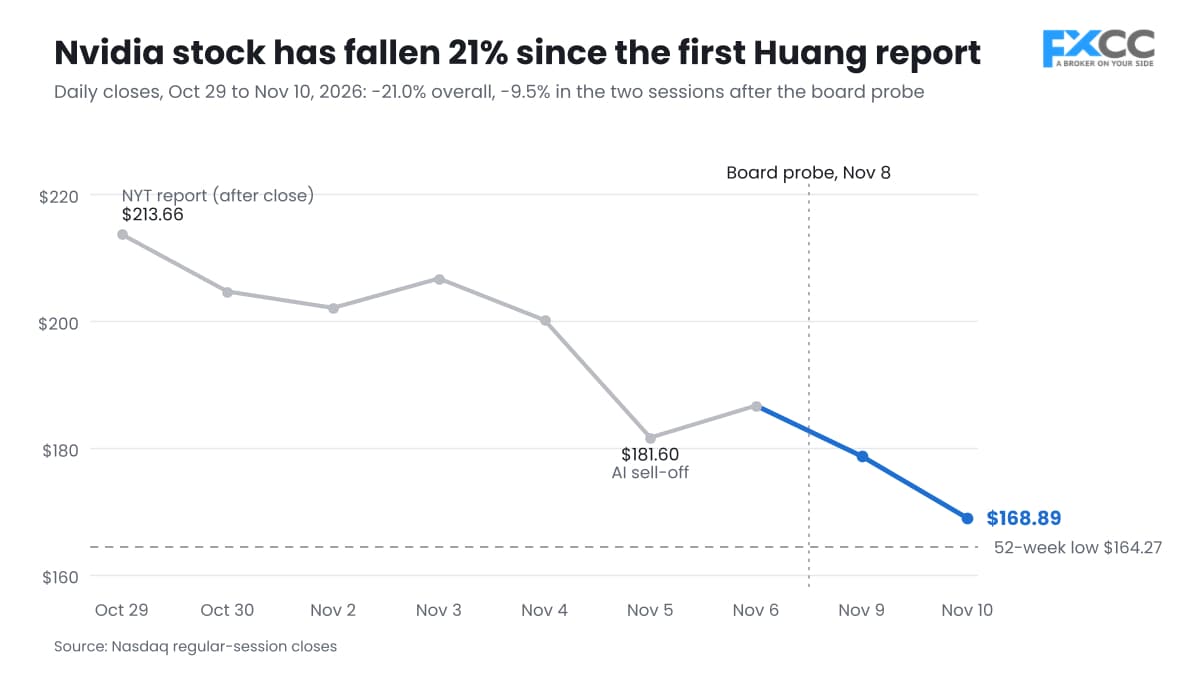
Nvidia closed lower in six of the eight sessions after the first report, and the two biggest drops on the chart (November 5 and November 10) came for different reasons.
Why the selling feels different now
Up until Tuesday, the story had been mainly about one man’s judgment and whether he should continue in his position as Nvidia CEO. The Information’s report, if it holds up, points at something investors can put a cost on: export-control compliance. Fines or new sales restrictions are the kind of outcome traders can try to price.
That’s the bear case. The Motley Fool’s Jeremy Bowman put it plainly on Tuesday: the shares deserve to trade at a discount while investigations are open, since Huang could be made to step down or the company could face restrictions or fines.
The bull argument hasn’t gone away. Bernstein analysts wrote on Monday that “demand for the company’s products seems unlikely to be affected,” and South Korea’s government said it expects no disruption to contracted GPU deliveries. More than 90% of analysts covering the stock still rate it a buy, according to FactSet data cited by The New York Times on Monday.
The levels on the chart
In Monday’s article, the first reference point was $181.60, the November 5 close. Nvidia has now closed below it twice. Friday’s close of $186.64, the last price before the probe was announced, now sits above the market.
The next level is the 52-week low of $164.27, set at the end of March. Tuesday’s close left the stock less than $5 above it. Nvidia is also about 29% below its record close of $239.24 from October 6.
Dates to watch
Wednesday, November 11, is the deadline the Republican chairs of three House committees gave Huang to accept a closed-door briefing on November 18 or propose another date.
Nvidia reports its fiscal third-quarter results on November 17, with the call at 2 p.m. Pacific time. It’ll be the first time management takes questions from analysts since the probe began. Strong numbers haven’t always lifted the stock: it fell the next trading day after six of its last 10 reports, even when revenue beat the top of guidance, The Motley Fool noted.
The board’s findings are still the biggest unknown. It has said who’ll run the review, but not when it’ll report. Until then, each new allegation lands on a stock already sitting near its lows.