
Nvidia went 11 days without Jensen Huang as CEO before its board voted unanimously to bring him back on Monday, November 23. In between, the stock lost about a third of its value, the board said it had no plans to reinstate him, and the President of the United States said he’d personally talked the directors round.
We’ve detailed how this story developed in four blog posts. Here’s the full run of events in order, with Nvidia’s close at each turn and the probes still underway.
How it started
The first crack came on October 29, when The New York Times reported that US intelligence officials believed Alice Huang (no relation), a former executive at Singapore-based Megaspeed, may have been passing information to Beijing. Megaspeed buys Nvidia AI chips. China’s Foreign Ministry called the allegations unsubstantiated.
On Sunday, November 8, Nvidia’s board opened an independent investigation into whether Jensen Huang had been the target of a foreign intelligence effort and whether any company secrets leaked. The same day, Huang admitted to employees in an email that he’d been unfaithful to his wife. The board said it still had confidence in him.
The timing of that investigation was considerably less than perfect: Nvidia had already seen a 9.3% drop on November 5 during the post-midterm AI sell-off, closing at $181.60. We covered the probe and what it could mean for the AI trade in our first post on the investigation.
The stock starts to slide.
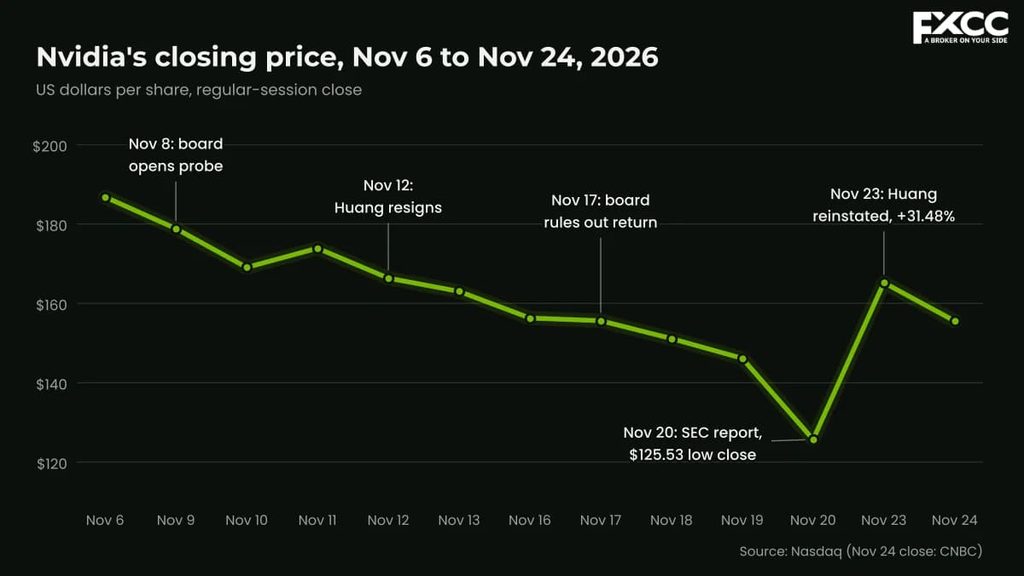
Nvidia closed at $186.64 on Friday, November 6, the last close before the probe was announced. It fell 4.27% to $178.67 on Monday, November 9, then another 5.47% to $168.89 on Tuesday.
That Tuesday, The Information reported that companies controlled by Alice Huang had been instrumental in moving at least $7.5 billion of Nvidia chips to Chinese firms (Reuters said it couldn’t verify the report). The board hired Joon H. Kim, a former acting US Attorney for the Southern District of New York, along with the law firm Wachtell, Lipton, Rosen & Katz. Our second post charted the price through those two sessions.
Jensen Huang resigns
The Times reported a second allegation on November 11, this time involving a relationship between Huang and a senior Nvidia executive who reported directly to him. Nvidia shares rose 2.87% to $173.73.
Before the US market opened on November 12, Nvidia announced that Huang had resigned as president, CEO, and board member, ending his 33-year tenure at the company he co-founded in 1993. CFO Colette Kress took over as interim CEO while retaining her finance role. Longtime director Harvey Jones became the company’s first chair.
Nvidia shares fell 14% at the open, touched $148.80 and recovered to close at $166.19. We covered his departure and the market reaction in our resignation post.
A record quarter, and a firm no
Nvidia reported results on November 17 for the quarter to October 25, which was still Jensen Huang’s quarter. Revenue came in at $115.8 billion, up 103% from a year earlier, and next-quarter guidance of about $130 billion beat the consensus. Kress raised the company’s growth outlook.
The question of leadership was the hot topic at Nvidia. Hours earlier, Huang had posted that he’d be “honored” to return if the board wanted him. Jones opened the earnings call by saying the board “does not intend to reinstate Jensen as CEO.”
Nvidia finished the following day with the stock at $150.96. That’s the lowest closing price since June 2025. We covered the results in our earnings post, including the full figures.
The worst week since 2008
California Attorney General Rob Bonta served Nvidia with a subpoena on Thursday, November 19. The subpoena targets whether Nvidia’s or Huang’s actions allowed China to access advanced chips, and whether the company misled investors about the potential risk.
Nvidia closed at $145.98.
On Friday, Reuters reported that the SEC was looking into Nvidia’s accounting practices (the SEC declined to comment). Nvidia fell 14.01% to $125.53, after touching a new 52-week low of $124.50. AMD, Broadcom and Micron each lost more than 12%, and the Nasdaq Composite fell 5.28%. For Nvidia, it was the worst week since October 2008, and from the November 6 close to that Friday it had lost 32.7%.
Eleven days later, he’s back.
According to a CNBC report, senior government officials briefed the board late in the week that no national security laws had been broken. That update led directors to reach out to Huang. They spoke on Saturday, and on Sunday the board decided to bring him back.
Nvidia announced it on Monday, November 23. The board said it was satisfied with Jensen Huang’s “candor and ability to lead.” That input from senior levels of the US government left it confident his return “poses no national security risk.” Huang said he was “honored to return.” Kress stays on as CFO and Jones stays as chair.
President Trump told CNBC he’d spoken to the board “directly and indirectly” and later said, “I made the deal.” Musk, Altimeter’s Brad Gerstner and Atreides’ Gavin Baker had all lobbied for Huang’s return in the days before.
Nvidia closed up 31.48% at $165.05, adding nearly $1 trillion in market value in one session, while the S&P 500 gained 4.73% and the Nasdaq rose 6.51%. Nomura strategist Charlie McElligott attributed part of the rally to mechanical buying, short covering, and options dealers unwinding their hedges.
The rebound didn’t last long. On Tuesday, November 24, Nvidia fell 5.86% to $155.38. That fall wasn’t confined to Nvidia. Other chip manufacturers like Micron, AMD and Arm each lost more than 8%.
The share price, start to finish.
| DATE | EVENT | NVIDIA CLOSE |
|---|---|---|
| Oct 6 | Record close | $239.24 |
| Nov 5 | Post-midterm AI sell-off | $181.60 |
| Nov 6 | Last close before the probe | $186.64 |
| Nov 9 | First session after the probe | $178.67 |
| Nov 10 | Chip transfer report, law firm hired | $168.89 |
| Nov 11 | Second allegation reported | $173.73 |
| Nov 12 | Huang resigns | $166.19 |
| Nov 17 | Q3 results; board rules out a return | $155.46 |
| Nov 18 | First session after results | $150.96 |
| Nov 19 | California subpoena | $145.98 |
| Nov 20 | SEC accounting report | $125.53 |
| Nov 23 | Huang reinstated | $165.05 |
| Nov 24 | Rally cools | $155.38 |
Despite Monday’s jump, Nvidia shares finished Tuesday 16.7% below their level before the probe began and 35.1% below their October record.
What’s still open
Nvidia says the board’s independent investigation into whether a foreign intelligence operation targeted Huang will “proceed to conclusion”. Huang has committed to cooperating.
The company is also creating a chief compliance officer role and a board committee to oversee national security and export controls.
The California Attorney General subpoena as well as the reported inquiry by the SEC are still open. On Capitol Hill, Senator Elizabeth Warren described the reinstatement as “reckless.” Warren is due to take over the Senate Banking Committee in January.
Analysts differ on how much of a threat the investigations pose to the stock. Piper Sandler’s David O’Connor doesn’t expect the hearings to have much impact, given the government’s national security assurances. StoneX’s Cody Acree sees the board investigation as the “key risk”. Any finding that confidential information was shared would put the leadership question back on the table.
Senior Analyst at Bernstein Stacy Rasgon had questioned the board’s initial decisions. It ruled out a return on November 17, then reversed itself six days later.
Dates to watch
- November 25: Treasury Secretary Scott Bessent’s deadline for Nvidia to tell the administration whether it set up shell companies to get around export controls.
- December 1: Huang’s closed-door interview with the House Foreign Affairs, Intelligence and China Select committees. That’s the day Huang was due to give the keynote at Nvidia’s GTC conference in Washington, D.C., before he resigned.
- December 2: Nvidia general counsel Tim Teter will appear before the same panels.
- December 3: Huang will have to testify publicly before the Senate Banking Committee. He will be the hearing’s only witness.
- No date announced yet: the results of the board’s own investigation.
Huang is back as CEO, but the investigations that led to his departure are still ongoing. He’s due to appear before Congress twice in the first three days of December.

CFDs are complex instruments and carry a high risk of rapid losses due to margin trading. Consider whether you understand how CFDs work and whether you can afford the risk of losing your money. This article is for educational purposes and is not investment advice.