

For the first time in 33 years, Nvidia’s investors are asking whether Jensen Huang will still be running the company a year from now. On Sunday, the chipmaker’s board opened a probe into whether its founder and CEO was the target of a suspected Chinese spy operation. We look at how this might impact Nvidia stock prices.
This is the second strike in just one week. On November 5th, the stock was already down by 9.3% as the AI sell-off after the midterm election continued its carnage. From the trader’s perspective, the personal aspect doesn’t matter. The issues that move the market are straightforward: how much lower can this stock go, what happens if Huang is out, and does this take down the rest of the AI trade?
What happened
On Sunday, November 8, Huang told Nvidia employees in an email that he’d been unfaithful to his wife and apologized to his family and colleagues, according to Axios. It followed reports about his ties to Alice Huang (no relation), a former executive at Megaspeed, a Singapore-based company that buys Nvidia’s AI chips.
Last month, The New York Times reported that US intelligence officials believed Alice Huang may have acted as an intelligence asset for Beijing. China’s Foreign Ministry has called the allegations unsubstantiated.
The money involved explains Washington’s interest. Megaspeed’s Malaysian affiliate bought at least $4.8 billion of AI equipment containing Nvidia technology between June 2024 and February 2026, and US authorities have been examining whether that helped China get around export controls.
Nvidia’s board has set up a committee of independent directors, working with outside lawyers. It’ll look at whether a foreign spy effort targeted Huang and whether any secrets were leaked. So far, it has “no reason to believe” either was, and it says it still has confidence in Huang. He’s committed to cooperating with the review.
How Nvidia stock reacted
Nvidia stock fell in early trading on Monday, November 9. Depending on the venue and the time, it was down about 3% to 5% from Friday’s close of $186.64. A 5% fall, if it held, would wipe roughly $225 billion off the company’s market value.
That’s a big number, but the stock was already under pressure. On November 5, it closed at $181.60, its lowest finish since April, and turned negative for the year. It bounced 2.8% on Friday.
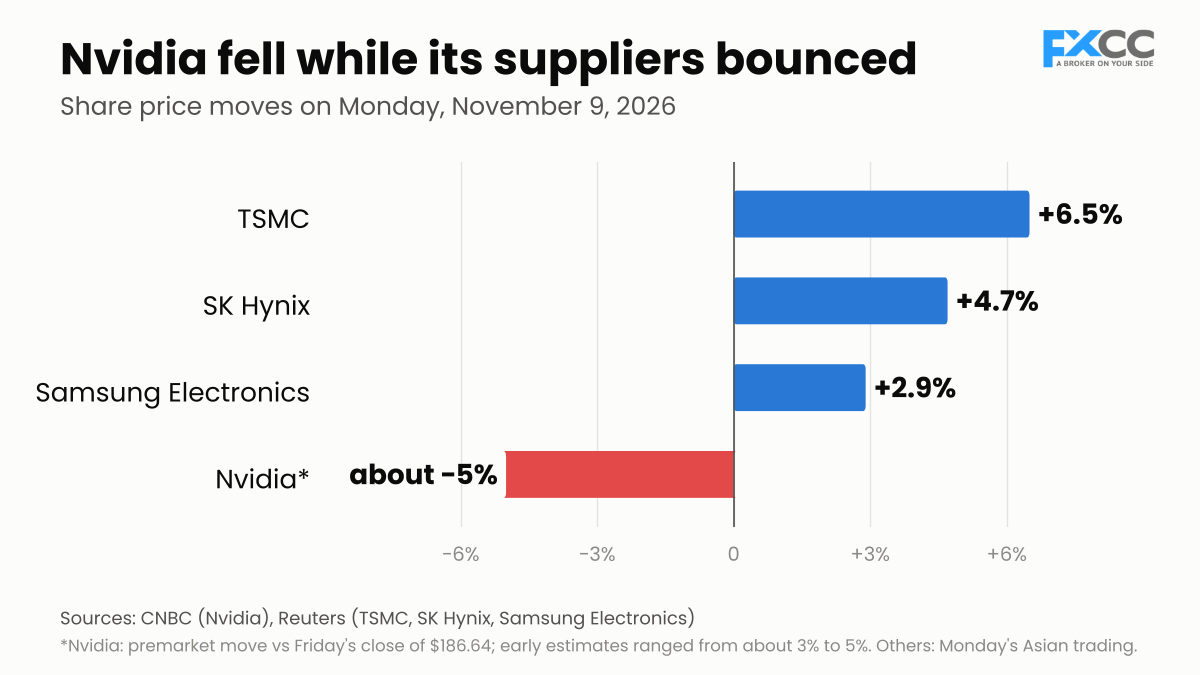
The more telling detail is what everyone else did. Nvidia’s big Asian suppliers rebounded on Monday: TSMC jumped 6.5%, SK Hynix 4.7% and Samsung Electronics 2.9%. For now, the market seems to see this as Nvidia’s own problem. That could change if the probe leads to tighter limits on chip sales or hurts Nvidia’s ties with customers.
The levels on the chart
The first reference point is $181.60, the November 5 close. The Nvidia stock price is back above it. A close back below would suggest buyers are struggling to hold the lows.
Further down sits the 52-week low of $164.27. A drop that far would leave Nvidia more than 30% below its 52-week high of $243.37.
Then there’s the 200-day moving average. Many traders use it to judge the long-term trend. Nvidia has traded either side of it since early November and closed well below it after the November 5 sell-off. On November 2, the average stood at about $204.46, so it’s now overhead, where it tends to act as resistance; a sustained move back above it would suggest selling is easing.
The key-man problem
This is where the real risk sits. Huang co-founded Nvidia in 1993 and has run it ever since. He still owns roughly 3.5% of the company. To most investors, he’s Nvidia: the CUDA software platform, the sovereign AI deals, the ties to OpenAI and Microsoft.
Nvidia has never published a formal succession plan. Names like Ian Buck and Bryan Catanzaro come up when analysts talk about the bench, but no one is anointed as the successor. Until this weekend, that was a distant question about retirement.
Dan Ives of Yorkville Ives summed it up in a note on Sunday: “The key question investors will be asking is: Will Jensen remain CEO of Nvidia?” He expects Huang to stay on in the near term, but warned that “there is clearly risk that Jensen could be removed as CEO depending on the Board investigation.” He also expects the episode to spark multiple congressional investigations and more scrutiny of chip sales to China.
What if Huang has to step down?
Nobody’s saying that’s the most likely outcome. The board has backed him, and so has President Donald Trump. Still, the market will start to price it in long before any decision, more so if the probe drags on.
The bear case is simple. Huang’s ties with customers, suppliers and governments have driven much of Nvidia’s growth. Replacing him while Washington is watching could shake confidence in where the company is heading. Analysts told Reuters a long probe could also delay spending plans or product launches, which would hit the whole chip supply chain.
The bull case is that Nvidia’s grip on the market doesn’t rest on one person. CUDA has about two decades of developer momentum behind it, and Nvidia’s hardware is built into the data centers of the world’s biggest tech companies. South Korea’s government said on Monday it expects no disruption to contracted deliveries of Nvidia GPUs. Demand for chips doesn’t disappear because a CEO does.
Could this deepen the AI sell-off?
Timing is the problem. The Nasdaq Composite fell 5.52% on November 5, its worst day since April 2025, and closed in correction territory, more than 10% below its October 6 record. The Philadelphia Semiconductor Index lost 12% the same day. Investors feared Democratic wins in Congress and in states like Texas and Georgia could slow permits for new data centers.
Nvidia is the world’s second-largest company by market value. In September, it made up about 8% of the S&P 500 and 8.44% of the Invesco QQQ, an ETF that tracks the Nasdaq 100, according to Benzinga. If Nvidia stock price keeps sliding, both indices feel it directly, regardless of what the rest of the sector does.
There are two separate risks here. Worries about AI spending hit the whole industry; the Huang probe is a question for Nvidia alone. Monday’s trading suggests investors are keeping them apart, at least for now.
What to watch next
November 17 is the first big date, when Nvidia reports its fiscal third-quarter results (the call starts at 2 p.m. Pacific time). Expect as many questions about the probe as about chip demand.
The next day matters too. In a letter dated November 4, the Republican chairs of three House committees asked Huang for a closed-door briefing on November 18 about his contact with Alice Huang and Nvidia’s protections against foreign espionage. They gave him until November 11 to accept or propose another date.
Then there’s the APEC summit in Shenzhen, where Presidents Trump and Xi are expected to meet. Bloomberg reported that the episode might complicate those talks.
The biggest driver, though, is the board’s investigation. A clean result could lift the cloud quickly. Evidence that information was compromised would be a much bigger problem, and a stock still nursing last week’s losses has little room for that.
CFDs are complex instruments and carry a high risk of rapid losses due to margin trading. Consider whether you understand how CFDs work and whether you can afford the risk of losing your money. This article is for educational purposes and is not investment advice.