
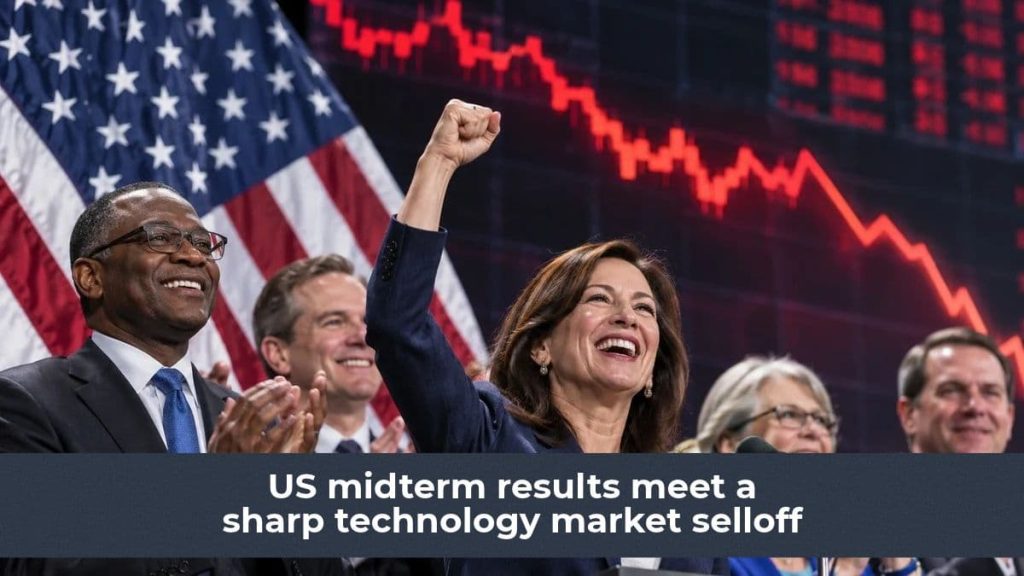
The US midterm elections initially gave Wall Street something to celebrate. On Wednesday, November 4, the Dow Jones Industrial Average jumped 3%, its best post-midterm session since 1982, CNN reported. The S&P 500 rose 1.58%, and the Nasdaq Composite gained 1.44%, helped by a sharp drop in oil prices and falling bond yields. There was little to point to the sharp AI selloff that followed, a development we covered in our week-ahead preview.
By Thursday, the mood had turned. Technology shares came under heavy selling as investors weighed what Democratic control of Congress could mean for America’s artificial intelligence industry. The Nasdaq fell 5.5%, the S&P 500 lost 4.4%, and the Dow dropped 3.4%, erasing Wednesday’s gains. Yahoo Finance reported it was the Dow’s worst second session after a midterm in data going back to 1896, and the worst day for the Nasdaq and the S&P 500 since the April 2025 tariff crash.
Other factors also drove the selling, beyond the elections. Technology stocks have struggled since October, with the Nasdaq recording its largest decline since March 2025. Weaker-than-expected guidance from Amazon and Alphabet also contributed to the market’s poor performance, and Intel’s shares fell by almost 29%.
The election has introduced a political element into that mix. Now that the Democrats control Congress, investors have to consider whether increased oversight of data center builds may hinder growth in that sector.
However, a bigger issue is driving the market reaction. The AI boom depends on an enormous physical buildout, and that project is running into problems with electricity supply, equipment, financing, and local opposition.
For financial markets, the consequences reach well beyond technology shares. The pace of AI investment now feeds into energy demand, industrial metals, corporate borrowing, and the outlook for US inflation and interest rates.
The electricity problem behind the AI boom
Data center growth in America cannot go unnoticed. Data centers in America will consume between 9.5% and 15.3% of total electricity use by 2030. Lawrence Berkeley National Laboratory projected this percentage at 11.8%. This projection varies according to the rate of computing demand growth.
That’s a substantial challenge for an electricity grid that wasn’t designed around thousands of large computing facilities.
Building a data center is one part of the process. Connecting it to a reliable power supply is another. New power plants and grid connections can take years. Developers want capacity online much sooner.
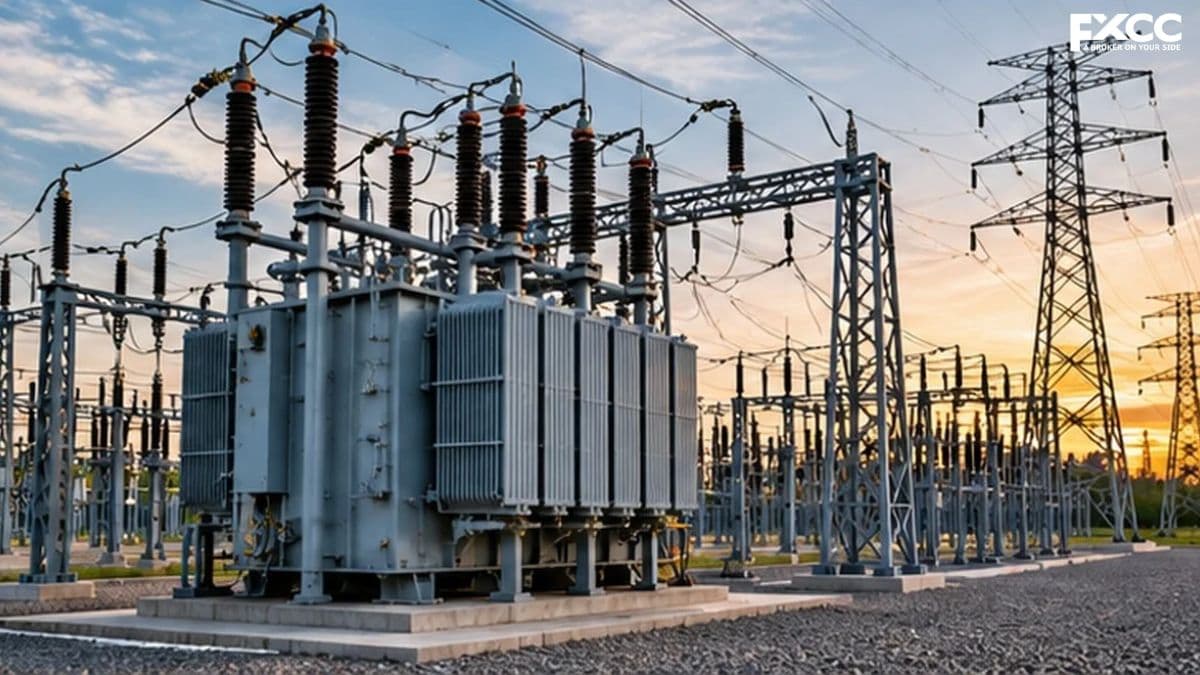
Secondly, equipment shortages are another problem. The high-voltage transformers that regulate electricity flows in the grid system have been difficult to obtain. Some orders can now take several years, instead of one year, as seen between 2020 and 2021.
That has knock-on effects for energy markets. Natural gas is likely to remain an important part of the US power mix, while nuclear power and renewables are also expected to attract investment.
For energy traders, the question is how quickly supply can respond to rising demand. If electricity consumption grows faster than generation and grid capacity, higher power costs could add to inflationary pressures. Natural gas prices and energy-related equities will be among the markets to watch.
Copper and the cost of building AI infrastructure
Electricity isn’t the only constraint. Data centers need large amounts of copper wiring and cabling, along with switchgear and specialist cooling equipment.
Copper runs through power systems and transformers, so the data center boom adds another source of demand for an already important industrial metal. That gives traders another way to follow the infrastructure story.
However, copper isn’t a pure AI trade. Its price also depends on China’s factories and on how much metal the mines can deliver.
The metal hasn’t escaped the AI selloff, though. Copper fell 3.2% on Tuesday, November 3, to $13,883 a tonne on the London Metal Exchange, before recovering above $14,100 on Wednesday after the election. That still left it well below its September record of $14,875.
China is pulling in the other direction. Physical demand there remains firm, and the premium for imported copper at Yangshan is near $200 a tonne, its highest in more than a decade.
The election has also lowered expectations of US tariffs on refined copper. Earlier tariff fears drew metal into American warehouses and squeezed supply elsewhere, helping push prices up.
Political opposition puts future projects in focus
Opposition to new data centers has been growing in US communities worried about electricity bills and water use. The midterm results have given that opposition more political weight, particularly in states where new governors campaigned on restricting data center development.
Texas matters most. The state accounts for 25% to 30% of the data center capacity expected to come online by 2030, according to Dan Ives of Yorkville Ives & Co., as reported by Yahoo Finance. It’s also already paused: outgoing governor Greg Abbott suspended data center approvals before the election, and Governor-elect Gina Hinojosa proposed a temporary ban on construction during her campaign. Keeping the existing pause in place would be straightforward.
Georgia, the third-largest data center market, is another state to watch. Governor-elect Keisha Lance Bottoms campaigned on pausing new construction and has said she’ll sign an executive order to do so.
Much of the pressure is coming from the local level, too. As of Wednesday afternoon, voters had approved 38 ballot measures restricting data centers in communities across several states.
Timing matters for investors. Facilities already under construction are less exposed than projects still waiting for permits or power connections. Oxford Economics analysts said a more restrictive stance toward data centers would stretch the timelines of future projects.
For semiconductor manufacturers, that could eventually affect the timing of future chip orders. The impact isn’t likely to be immediate while existing construction continues. Utilities and equipment suppliers face similar uncertainty over where and when new capacity will be needed.
The financing question: who pays for the AI expansion?
The amount of money involved adds another layer of risk.
According to S&P Global Ratings, combined capital expenditure by six major hyperscalers (Alphabet, Amazon, Microsoft, Meta, Oracle and SpaceX) is expected to exceed $1.3 trillion by 2027.
The same research highlights a growing financing challenge. S&P expects all six companies to generate negative free operating cash flow in 2026 and 2027, with a recovery not projected until 2029.
Free cash flow is the money a company has left after paying its operating costs and capital spending. When it turns negative, a business must use cash reserves or borrow to cover the gap.
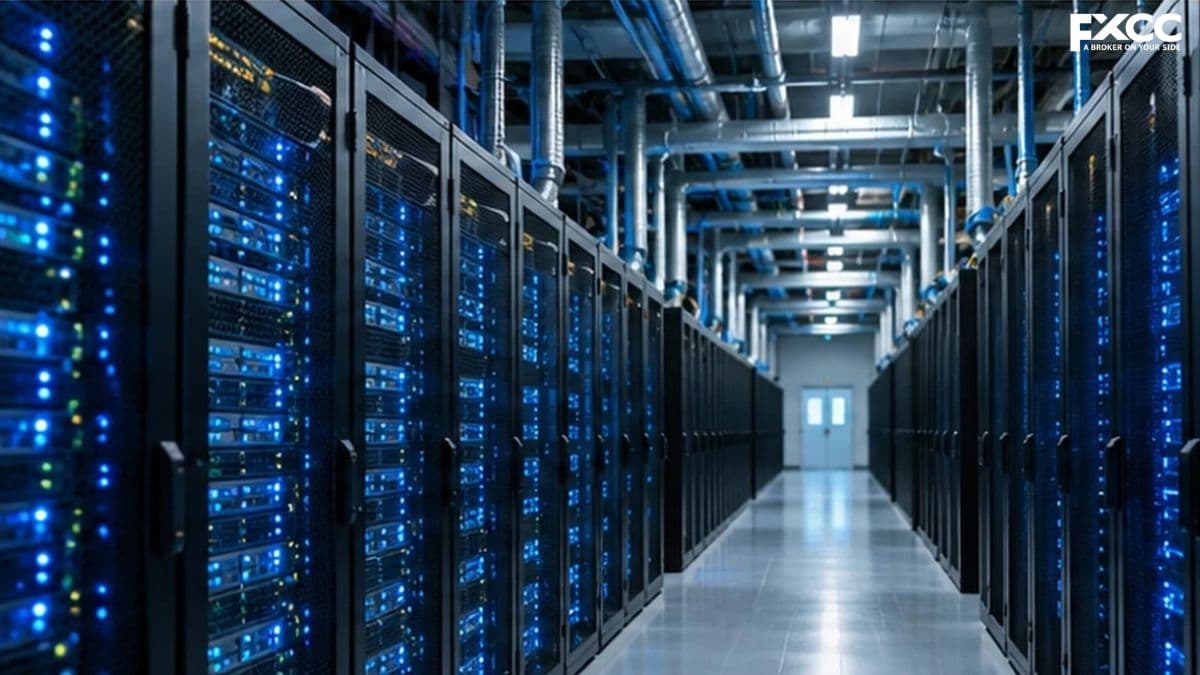
The largest technology groups have deep pockets, but the scale of their spending is changing how they pay for it. S&P notes that debt and leases are taking on a bigger role.
That raises questions about how much more debt the market will absorb, and whether revenue from AI services will justify the spending.
If demand grows more slowly than expected, infrastructure providers could end up carrying heavy financing costs while running below the capacity they planned for.
Investors are already scrutinizing the cash-flow impact of AI investment. That pressure could spread to corporate bonds and credit markets, particularly if borrowing costs stay high or companies have to revise their expected returns.
What it means for the Fed and the dollar
The AI infrastructure story is becoming increasingly relevant to US monetary policy.
Investment in data centers, power generation and electrical infrastructure supports economic activity. It creates work for builders, manufacturers and energy firms.
However, rising electricity demand and infrastructure costs could also add to inflationary pressures, particularly if supply struggles to keep pace.
The Federal Reserve will have to weigh both sides. A slowdown in AI investment could hold back business spending and growth, while higher energy costs could make inflation harder to control.
For currency traders, this week has shown how tangled the link between US yields and the dollar has become.
On November 4, Treasury yields fell, and the dollar weakened as investors digested the election results.
After Thursday’s equity selloff, demand for government bonds picked up again. The 10-year yield fell to around 4.84% in Asian trading on Friday, close to its lowest level since early September.
The Japanese yen has been the standout. USD/JPY briefly fell to 157.40, a one-week low, as investors sought safe havens. As US yields fell, the dollar’s safe-haven appeal has been blunted.
The dollar is caught in a tug-of-war. The dollar may be affected by weak US economic performance and expectations of low interest rates. Risk aversion could also support the dollar.
Gold has had a strong week. Spot gold rose more than 3% on Wednesday to around $4,060 an ounce as yields and the dollar fell, and it extended the rally on Thursday, trading above $4,100.
Gold and copper had a mixed response to the market reactions, with gold gaining on lower yields and defensive buying. In contrast, copper is more sensitive to worries about industrial output and potential infrastructure spending.
The next test for currency and interest rate markets is Friday’s US non-farm payrolls report for October. It’ll give investors another read on the labor market and help shape expectations for the Federal Reserve’s next policy decision.
The next phase of the AI trade
Midterm results have changed the political environment for America’s AI industry, but they haven’t removed demand for computing power. Technology companies are still investing in AI, and businesses continue to look for ways to use it.
The question facing investors is whether the infrastructure can be built quickly enough, at a cost that makes commercial sense, and with returns that justify the capital being committed.
Timing is particularly important. Projects already under construction should keep much of the planned investment on track. The bigger uncertainty concerns projects that haven’t secured permits yet.
Restrictions on new data centers could eventually affect semiconductor demand and technology valuations. Electricity shortages could push up energy prices, while higher financing costs and weaker returns could change expectations for US corporate earnings.
The AI investment cycle has become an important driver of US market performance. Its next phase will depend on whether the companies leading the expansion can turn their enormous infrastructure spending into sustainable revenue.
CFDs are complex instruments and carry a high risk of rapid losses due to margin trading. Consider whether you understand how CFDs work and whether you can afford the risk of losing your money. This article is for educational purposes and is not investment advice.