
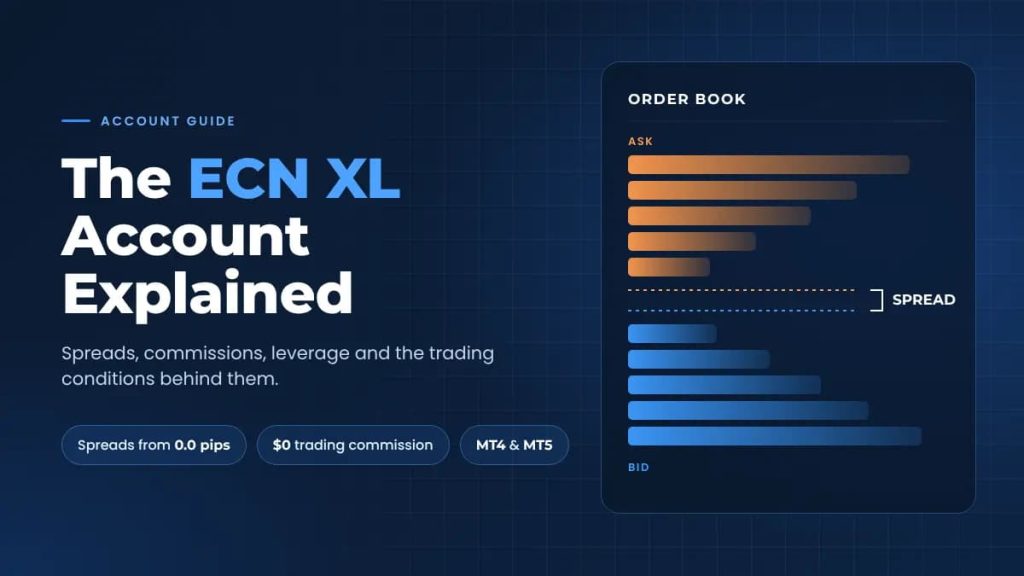
Most traders choose an account based on two numbers: the spread and the commission. Both matter. Neither tells you the whole story. To set the record straight, here’s the whole story about our flagship account, the ECN XL.
How your orders are handled, how much leverage you can use (and whether you should), which platforms you can run, how much it costs to fund the account, and which markets you can actually trade all shape what it’s like to live with a trading account. A low headline spread on an account that doesn’t suit your strategy is just a nice number on a pricing table.
This article will walk you through the FXCC ECN XL account in detail. We’ve been perfecting our ECN trade environment since 2011 when we first created FXCC. Since then, we’ve fine-tuned our account parameters, and the result is what we can confidently claim is the best trading account available today.
Full disclosure: this article is published by FXCC, about an FXCC account. It’s not an independent review. We’ve written it to explain the account properly, including the parts that don’t fit neatly on a banner.
What Is the FXCC ECN XL Account?
The ECN XL account is FXCC’s main live trading account. It runs on what FXCC describes as an STP/ECN execution model, uses floating spreads starting at 0.0 pips, and charges no trading commission. You can trade it on MT4 or MT5 across forex, metals, energy, indices, crypto, and equities.
Two acronyms need unpacking here. STP stands for straight-through processing: your order is passed on to liquidity providers rather than being filled by a broker’s own dealing desk. ECN stands for electronic communication network, a setup where multiple market participants provide prices and orders are matched electronically. FXCC explains both in more depth in its What is ECN? and ECN vs. Dealing Desk guides.
These are important terms because they define how your orders reach the markets. They can’t guarantee a better price on every trade. That still depends on liquidity, timing, and market conditions at the time, but the term ECN defines the routing of your trades.
Spreads From 0.0 Pips and Zero Commission: What Does That Actually Mean?
There are two main ways a broker gets paid for executing your trade. The spread is the gap between the bid price (what you can sell at) and the ask price (what you can buy at). A commission is a separate, explicit fee some brokers charge per lot when you open or close a position.
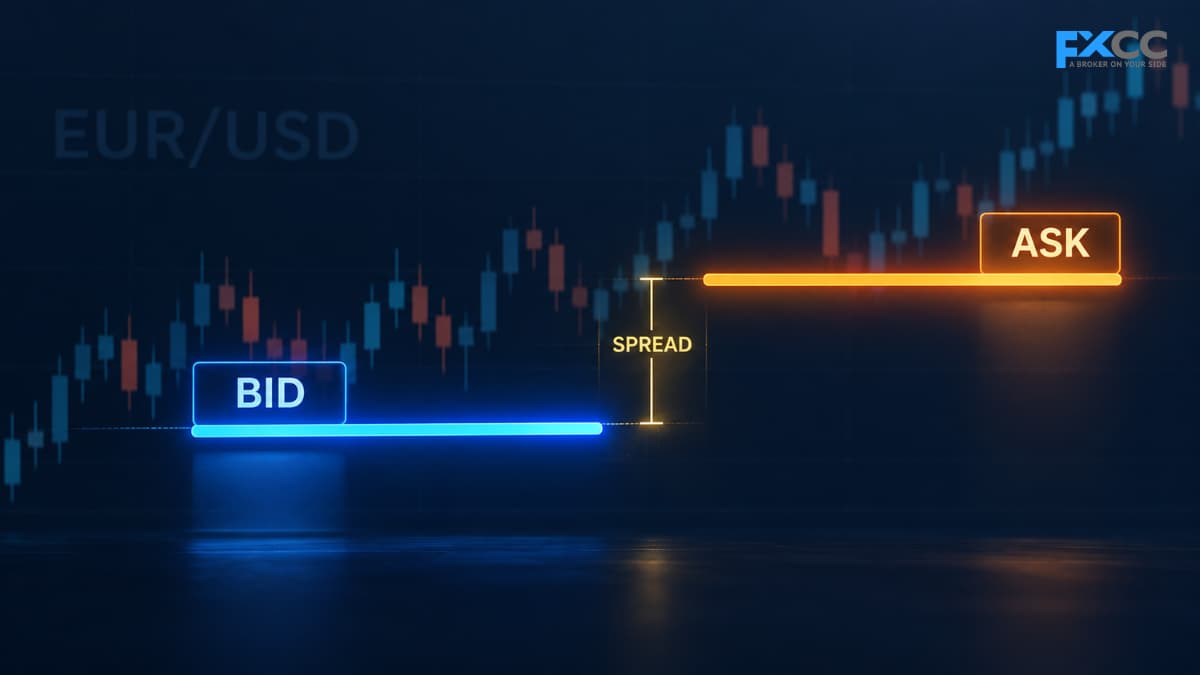
The ECN XL account charges no trading commission. Your main transaction cost is the spread, which floats with the market and starts from 0.0 pips.
“From 0.0 pips” is a floor, not a promise
A 0.0-pip spread looks wonderful on a pricing table. The more useful question is what spread you actually get when you trade, particularly when markets get busy.
Spreads fluctuate. Spreads tend to be tighter when liquidity is high in the most popular currency pairs. This happens when trading hours overlap, leading to high trade volumes. Spreads widen when trading volume is low; this typically happens during daily roll-over times, holiday periods, or just before major news, such as the US Non-Farm Payrolls or central bank decisions. “From 0.0” only indicates where the spread range begins.
If you want more than the headline, FXCC publishes average effective spreads as part of its execution transparency pages. That’s a better guide to typical conditions than any “from” figure.
A worked example (illustrative figures)
The numbers below are hypothetical, chosen to show the arithmetic. They are not FXCC live prices.
On EUR/USD, one standard lot is 100,000 units of the base currency, and one pip is worth about $10 per lot. You pay the spread once per round trip, because you buy at the ask and later sell at the bid.
| Scenario (1 standard lot, EUR/USD) | Spread | Spread Cost | Commission | Total Transaction Cost |
|---|---|---|---|---|
| Calm, liquid session | 0.2 pips | $2 | $0 | $2 |
| Moderately active market | 0.8 pips | $8 | $0 | $8 |
| Seconds after a major data release | 3.0 pips | $30 | $0 | $30 |
Same account, same pair, same size. The cost of getting in and out ranged from $2 to $30 because the market changed, not the account.
Zero commission isn’t the same as zero cost.
Zero commission is a useful starting point when comparing accounts. It doesn’t mean every trade is free.
When you set out to compare trading accounts, make sure to add up everything. The spread you typically pay, any commission, swaps on overnight positions, and any funding or conversion charges from your payment provider. An account with a wider spread and no commission could end up cheaper or more expensive than one with raw spreads plus a fee. It depends on what you trade and how often.
None of this affects market risk. A trade that costs $2 to open can still lose far more than $2.
ECN/STP Execution: Why Order Handling Matters
Execution is what happens between you clicking “buy” and the trade appearing in your account. It sounds instant. Usually it nearly is. But the details decide what price you actually get.

FXCC describes the ECN XL account as using STP/ECN execution with live streaming prices and no dealing desk intervening in your orders. The account page also states there are no re-quotes, meaning the platform won’t come back asking whether you’ll accept a different price.
Four things worth separating
It helps to keep these apart in your head:
- The price on your screen when you submit the order.
- The price your order fills at. Usually the same or very close. Not always.
- The spread at the moment of execution, which may differ from the spread a second earlier.
- Slippage, the difference between the price you requested and the price you got.
Slippage, in plain English
Without re-quotes, a market order is filled at the best available price when it reaches the market. If the price has moved in the milliseconds since you clicked, you get the new price. That’s slippage. It can work against you, and it can also work in your favor.
Slippage is most likely when prices move fast or liquidity drops, for example, in the first seconds after a major data release or when markets reopen after the weekend. FXCC has a short explainer on slippage if you want the mechanics.
Leverage Up to 1:1000: Flexibility Comes With Responsibility.
Leverage lets you control a position larger than the money you put up. That’s useful to understand. It’s also where a modest market move can become a very expensive lesson.
With 1:1000 leverage, the initial margin is only 0.1% of the trade value. A $1,000 position would require $1 of margin, assuming the maximum leverage applies to the trade. On our ECN XL account, you can trade with leverage up to 1:1000, but the maximum available can vary by instrument and account circumstances.
A worked example (illustrative figures)
Say EUR/USD is trading at a hypothetical 1.1000 and you buy one standard lot. The position is worth $110,000.
| Leverage | Initial margin Required | Loss From Negative 50 Pip Move | Loss As A Share Of Margin |
|---|---|---|---|
| 1:1000 | $110 | $500 | about 4.5 times the margin |
| 1:100 | $1,100 | $500 | about 45% of the margin |
| 1:30 AM | $3,667 | $500 | about 14% of the margin |
Look at the third column. The loss is $500 in every row because the position size is the same. Leverage didn’t change the trade’s risk. It changed how little money you needed to take it, and therefore how much of your account a normal move can eat.
Margin is not your maximum loss.
This is the part people get wrong. The $110 of margin in the first row is a deposit to open the trade, not a cap on what you can lose. Your profit or loss comes from the full $110,000 position. A 50-pip move on EUR/USD is an ordinary day, not a crisis.
In practice, any losses are limited by your stop-loss (if you set one and it fills), the account’s stop-out level (50% on ECN XL, covered below), and negative balance protection (also covered below). These determine the limits on your losses, not the leverage figure.
Using higher leverage is a tool, not a blanket recommendation. A lot of experienced traders use lower leverage, leaving their accounts more room to absorb normal price swings. Our guides to margin and our forex calculators are there to help before you scale any positions.
Negative Balance Protection: What Does It Mean Exactly?
The ECN XL specifications list negative balance protection. The idea is simple: if a fast market move pushes your account below zero before you can close positions, the balance resets to zero instead of leaving you owing the broker money.
That’s a real safeguard, but it’s worth being precise about its limits. It protects you from a negative balance. It does not protect your deposit. If your trades lose, you can lose everything in the account. Negative balance protection only applies after that point.
Is the ECN XL Account Suitable for Scalping and News Trading?
Both are permitted on the ECN XL account, along with hedging and Expert Advisors. Some brokers restrict one or both, so if either is central to how you trade, it’s a relevant detail. Permission, though, isn’t the same as profitability.
Scalping: where costs get magnified
Scalping involves opening multiple trades throughout the day to profit from small price movements, more often than not just a few pips at a time. That makes the transaction costs hugely important in the breakdowns. If you target 5 pips per trade and your spread is 1 pip, that’s a fifth of your gross target gone before the trade has gone anywhere. At 2 pips of spread, it’s two-fifths. That’s forty percent of your targeted profit. That’s a big part of the bottom line.
That bottom line is precisely why scalpers pay such close attention to typical spreads (not the “from” figure), fill speed, and how often they see slippage. The published specifications also state there is no minimum stop-loss distance, which matters if you place tight stops.
News trading: permitted is not the same as predictable.
Let’s take the US Non-Farm Payrolls release as an example here. In the seconds before, liquidity providers pull back. Spreads on major pairs can widen to several times their normal level. When the number hits, prices can jump 30 or 40 pips almost instantly, sometimes in both directions within a minute. These figures are illustrative, but anyone who has watched an NFP release live will recognize the shape.
In that environment, an order may fill at a noticeably different price than you saw, and a stop-loss can fill beyond its level if price gaps through it. The account allows you to trade the release. It can’t make the release behave.
If you trade the news, size your positions for the wider spread and the possible slippage, not for the calm-market version of the same trade.
Automated Trading and Expert Advisors on MT4 and MT5
An Expert Advisor (EA) is a program that runs inside MetaTrader and places, manages, and closes trades according to rules you define. Moving-average crossover with a fixed stop? An EA can do that around the clock without blinking.
An Expert Advisor can execute a strategy while you sleep. It can also execute a bad strategy while you sleep. Automation saves time, not common sense. It does one thing well: consistency; it follows the rules every time, without hesitation or second-guessing. It can’t turn poor rules into good ones.
EAs are permitted on the ECN XL account on both MT4 and MT5. If you’re new to the difference, MT4 uses MQL4, and MT5 uses MQL5, so an EA written for one won’t run on the other without being rewritten.
Running an EA on a VPS
An EA only works while your trading platform is up and running and connected. If your MetaTrader lives on your laptop, trading stops when you close the lid, the Wi-Fi drops, or Windows decides tonight’s the night for that crucial update.
A virtual private server (VPS) avoids any connection issues by running your platform on a remote machine that stays on and connected. You log in remotely, set up your EA, and close your computer. A VPS located close to the broker’s servers can also cut the time it takes for orders to travel, which matters most to strategies that trade frequently.
What a VPS doesn’t do is improve your strategy. It keeps the same rules running more reliably. That’s all.
The “free” VPS comes with conditions.
FXCC offers a free VPS, but only if you meet the qualifying conditions in the VPS terms. As published at the time of writing:
- You need to make a new deposit and maintain minimum equity of $2,500 (or the equivalent).
- You need to trade at least 30 standard lots round trip per month.
- If both conditions aren’t met in a given month, a $30 server fee applies, deducted from your trading account at the start of the following month, unless you tell FXCC you no longer need the service.
- The VPS is provided by a third party (BeeksFX), on an “as is” basis. FXCC doesn’t guarantee it will be free of errors or outages.
- One VPS per client, regardless of how many accounts you hold.
You apply through the Traders Hub after reading those terms.
Trading Markets and Platforms
The ECN XL account gives access to six market groups: forex, metals, energies, indices, crypto and equities. That means you can trade EUR/USD, gold and a stock index CFD from one account, without juggling logins.
The conditions aren’t identical across them, though. Trading hours, contract sizes, typical spreads, swap rates and maximum leverage all differ by instrument. Gold doesn’t trade like EUR/USD, and a crypto CFD on the weekend is a different animal. Check the instruments page and each product’s contract specifications before trading something new.
For platforms, you choose between MetaTrader 4 and MetaTrader 5. Both are available for desktop, iOS and Android, and through a browser via the MT4 and MT5 WebTrader. Mac versions are available too.
MT4 is the long-standing favorite for forex and has a vast library of EAs and indicators. MT5 adds more timeframes, a built-in economic calendar, more order types, and a faster strategy tester. Neither is objectively better. It depends on what you trade and which tools you already rely on.
The account also comes with free access to FXCC’s daily technical analysis and trading tools. Useful for context and ideas. Not a substitute for your own analysis, and not a signal service.
Want to try before committing real money? Open an ECN demo account with virtual funds and real-time prices.
No Minimum Deposit and Funding Conditions
The ECN XL account has no minimum deposit, and FXCC lists its own funding fee as waived. You can open the account and fund it with whatever amount you choose.
Two caveats worth knowing here. First, the “no minimum” is our rule. Your payment provider may have its own minimum transfer, fees, or currency conversion charges, and those come from the processor, not the broker. Second, a very small balance limits what you can sensibly trade. With 0.01 lots as the minimum trade size, tiny accounts can open positions, but there’s very little room to absorb a losing run.
You can hold the account in USD, EUR, GBP, or CAD. Picking the currency you’ll actually deposit in avoids paying a conversion spread every time money goes in or out.
The deposit methods page lists available funding methods, processing times, and any regional restrictions.
The 100% First Deposit Bonus: Read the Conditions
ECN XL account holders can opt in to a 100% bonus on their first qualifying deposit, up to a maximum of $2,000 (or equivalent). Deposit $1,000 and receive $1,000 in bonus credit. Deposit $3,000 and the bonus is capped at $2,000.
That sounds like doubled money. It isn’t, and the bonus terms and conditions explain why. The key points, as published at the time of writing:
- You have to opt in by email, live chat, or a tick box in the Traders Hub. It isn’t applied automatically, and FXCC can decline a bonus request.
- It’s trading credit, not cash. The bonus adds to your equity and free margin so that it can support open positions. It isn’t withdrawable money.
- Withdrawals reduce it. Withdraw from your wallet, and the bonus is canceled in proportion to the amount withdrawn.
- It can be removed if your account falls. If your balance plus floating profit or loss drops to 50% of the bonus credit or below, the whole bonus is removed automatically.
- Not available everywhere. The offer excludes clients in the European Economic Area, and other jurisdictional limits may apply.
Swap-Free Trading and Overnight Positions
When you hold a leveraged position past the daily rollover, you normally pay or receive a swap, an overnight financing adjustment based on the interest rate difference between the two currencies (or the financing rate on a CFD). FXCC’s rollover guide covers the mechanics.
The ECN XL account is available as Swap Free for all qualifying clients.
Swap-free doesn’t mean there are no rules about holding positions overnight. Account-specific conditions can still apply, so check the terms for the swap-free version before you switch.
The ECN XL Account Specifications
Conditions can vary by instrument and jurisdiction.
| FEATURES | ECN XL ACCOUNT |
|---|---|
| Trading commission | $0 |
| Spreads | Floating, from 0.0 pips |
| Minimum deposit | None |
| Minimum trade size | 0.01 lot |
| Maximum leverage | Up to 1:1000 |
| Stop-out level | 50% |
| Negative balance protection | Yes |
| Base currencies | USD, EUR, GBP, CAD |
| Markets | Forex, metals, energies, indices, crypto, equities |
| Platforms | MT4, MT5 (desktop, mobile, WebTrader) |
| Expert Advisors | Allowed |
| Scalping | Allowed |
| News trading | Allowed |
| Hedging | Allowed |
| Minimum stop-loss distance | None |
| Swap-free Islamic account | Available, no additional charges or fees |
| Funding fee (FXCC) | Waived |
| Server locations | New York, London, Germany, Hong Kong |
| First deposit bonus | 100% up to $2,000, terms apply |
A quick note on the stop-out level. At 50%, if your margin level (equity divided by used margin) falls to 50%, the platform automatically starts closing positions, beginning with the one losing the most, to stop the account from sliding further. It’s a safety net, not a strategy, and it closes trades at market prices, which may not be the prices you’d have chosen.
Who Does the ECN XL Account Suit?
There is no single account that fits everyone, and experience alone doesn’t define fit. A ten-year veteran who swing trades gold has different needs from a two-year trader running a scalping EA on EUR/USD.
The ECN XL account is worth a closer look if what matters to you is:
- A floating-spread pricing model with no per-trade commission.
- MT4 or MT5, including the freedom to run your own EAs.
- Permission to scalp, trade the news, or hedge.
- Control over how much leverage you use, up to a high ceiling.
- Several asset classes under one login.
- Starting with whatever deposit you’re comfortable with.
Before you open one, weigh up the other side honestly. Spreads float and will widen when markets are thin or fast. Slippage happens. High leverage magnifies losses as efficiently as gains. Overnight positions may carry swap costs unless you’re on the swap-free version. The VPS and the bonus each come with their own conditions. Everything depends on where you live, since some offers and services aren’t available in every country.
If the conditions match how you trade, a demo account is a sensible first step. It costs nothing and shows you real-time pricing on the same platforms.
Frequently Asked Questions About the ECN XL Account
What is the FXCC ECN XL account?
It’s FXCC’s main live trading account, using STP/ECN execution, floating spreads from 0.0 pips and zero trading commission, with access to MT4 and MT5.
Does the ECN XL account charge trading commissions?
No. The trading commission is $0. Your main transaction cost is the spread, and other costs, such as overnight swaps or third-party payment fees, may still apply.
Can spreads really start from 0.0 pips?
Yes, spreads can go as low as 0.0 pips. Spreads float with market conditions and are often wider, especially during periods of low liquidity or around major news releases. FXCC’s average effective spreads page gives you a precise look at how our spreads move during any given trading day.
What is the maximum leverage available?
Up to 1:1000. Maximum leverage can vary by instrument.
Is there a minimum deposit?
No, there is no minimum deposit, though your payment provider may have its own minimums or fees.
Does the XL ECN account support scalping?
Yes, scalping is permitted, and there is no minimum stop-loss distance.
Is news trading allowed?
Yes. News trading is allowed.
Can I use Expert Advisors?
Yes, on both MT4 and MT5.
Does FXCC provide a free VPS?
Yes, for clients who meet the conditions: a new deposit, minimum equity of $2,500, and at least 30 standard lots traded per month. Otherwise, a $30 monthly fee applies. See the VPS terms for details.
Which trading platforms are available?
MetaTrader 4 and MetaTrader 5 are available on desktop, iOS, Android, and in a web browser.
Does the account offer negative balance protection?
Yes. It prevents your account balance from going below zero. It does not protect you from losing the money you deposited.
Is a swap-free account available?
Yes. A swap-free Islamic version is available at no additional cost, subject to its terms.
Which markets can I trade?
Forex, metals, energies, indices, crypto, and equities. Trading conditions vary by instrument.
How can I open an ECN XL account?
Register on the FXCC account opening page, complete verification, and fund the account. You can also start with a demo account.
Explore the FXCC ECN XL Account
Zero commission, floating spreads from 0.0 pips, MT4 and MT5, EAs, scalping and news trading all permitted, and leverage you can dial up or down. That’s the account in a sentence. Whether it fits you depends on how you trade, and only you can judge that.
Review the trading conditions, platform options, and account terms to decide whether the ECN XL account fits your trading approach.
CFDs are complex instruments and carry a high risk of rapid losses due to margin trading. Consider whether you understand how CFDs work and whether you can afford the risk of losing your money. This article is for educational purposes and is not investment advice.