
Jensen Huang resigns as CEO of Nvidia Corporation on November 12, ending his 33-year stint at the company he co-founded in 1993.
The decision follows allegations that Chinese agents targeted Huang as part of an intelligence-gathering operation linked to his association with Alice Huang, a former executive at Singapore-based Megaspeed International.
Shortly before his announcement, a second New York Times report alleged an association with a senior Nvidia executive. Neither Huang nor that executive has confirmed it.
The Nvidia board had said earlier it had confidence in him. By Thursday morning, he was gone.
Why did Jensen Huang resign from Nvidia?
Nvidia has not given any reason for Mr. Huang’s resignation. His resignation came amid the US government looking into claims that Chinese spies had been trying to obtain information from him using connections within his professional network.
The initial report highlighted Alice Huang. A former executive of Singapore-based Megaspeed International, who had connections to Jensen Huang.
Speculation has suggested a link between Huang’s resignation and the investigation. Nevertheless, neither Nvidia nor Mr. Huang has confirmed any connection.
After his resignation, Nvidia’s board appointed Colette Kress, Nvidia’s chief financial officer, as interim CEO. Ms. Kress has served as Nvidia’s chief financial officer since September 2013 and will remain in this role as interim CEO. The board will consider both internal and external candidates for the CEO post.
Harvey C. Jones, Nvidia’s director since 1993, has been named Nvidia’s first-ever chair. Mr. Jones was the CEO and executive chairman of chip design software company Synopsys.
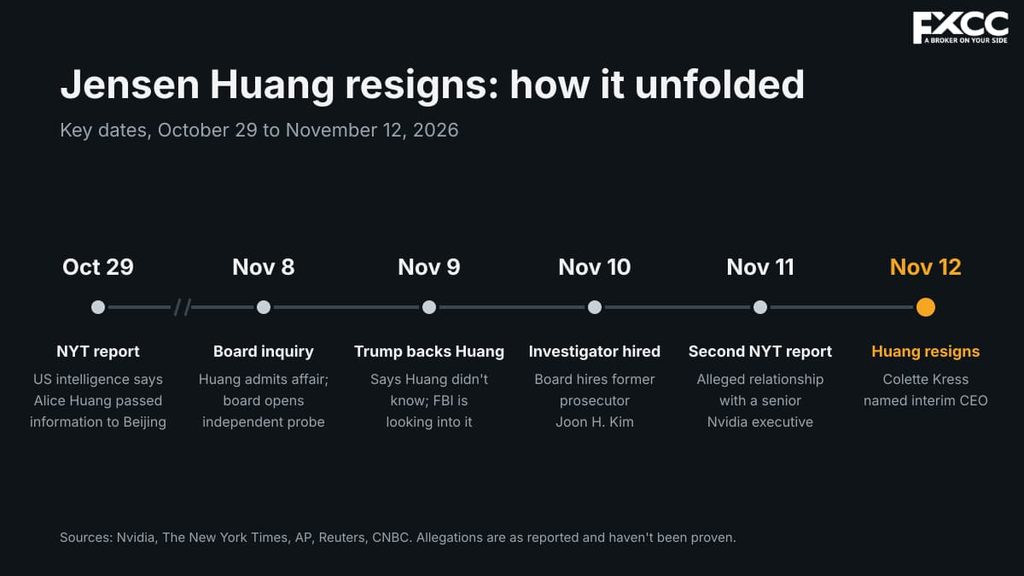
Timeline: how the Nvidia investigation unfolded
Questions about Megaspeed weren’t new. The New York Times first reported on the company’s Nvidia chip purchases and Alice Huang’s closeness to Jensen Huang in October 2025. It resurfaced in the news this autumn.
October 29: The intelligence report
The New York Times reported that US intelligence had concluded Alice Huang was passing information to Beijing, and that she’d developed a close relationship with Jensen Huang. The two aren’t related. China’s government called the allegations baseless.
According to an Nvidia spokesman, his interactions with her were just part of the job description. Megaspeed was one of Nvidia’s largest customers in Southeast Asia, and the news raised questions about AI chips being shipped abroad.
November 8: Huang admits an affair, and the board opens an inquiry
In a letter to Nvidia employees, Huang admitted that he’d been unfaithful to his wife, but didn’t identify anyone involved.
On the same day, Nvidia’s board announced an independent investigation into reports that foreign intelligence agents had targeted him.
A committee of independent directors would oversee the investigation, with help from external lawyers.
The board said it had no reason to believe national security or Nvidia’s confidential information had been compromised. It also said it continued to have confidence in Huang. He confirmed that he’d cooperate fully with the investigation.
November 9: Trump backs Huang
President Donald Trump said that he had talked to Huang, who said that he did not know anything about the woman being a spy. The president said that he trusted him and described him as an honorable man. The FBI was investigating the matter.
Separately, three Republican House committee chairs had already asked Huang to attend a closed-door briefing on November 18 about the relationship and Nvidia’s protections against espionage.
November 10: The board hires an ex-prosecutor
Nvidia’s independent directors hired Joon H. Kim, a former acting US Attorney for the Southern District of New York, and his firm Wachtell, Lipton, Rosen & Katz to run the investigation.
The same day, The Information reported that Alice Huang had used her ties to Jensen Huang to help move billions of dollars’ worth of Nvidia chips to Chinese firms. Reuters said it couldn’t independently verify that report.
November 11: A second allegation
The New York Times reported, citing five people who’d worked at Nvidia, that Huang had also had a relationship with a senior Nvidia executive who reported to him.
Neither Huang nor the executive has confirmed it, and Nvidia declined to comment to the Times.
Nvidia’s board met to discuss Huang’s future and confirmed in a filing that Jones had also been appointed chair that day.
November 12: Huang resigns
Nvidia announced Huang’s resignation before the US market opened.
How has Nvidia’s stock reacted?
Nvidia closed at $186.64 on Friday, November 6. It hasn’t been back there since.
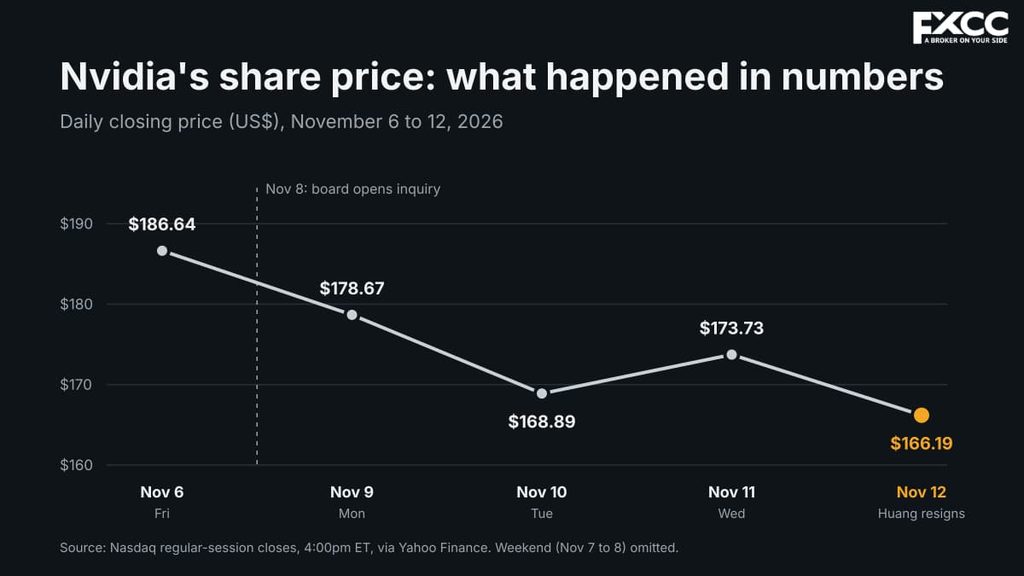
On Monday, November 9, the first session after the board’s announcement, the stock dropped as much as 9% shortly after the open. It recovered some ground and closed at $178.67, down 4.3%.
The slump carried over into Tuesday’s trading. According to Reuters, Nvidia was set to lose more than $470 billion in market capitalization during the two trading days.
The announcement of Huang’s departure on Thursday pushed the stock lower again. Nvidia stock fell by 14 percent at the open and traded at $148.80, but ended the day at $166.19, a 4.3 percent drop in the day’s trade and about an 11 percent decline from the price as of November 6.
This can’t all be attributed only to alleged infidelities on Jensen Huang’s part. Nvidia was already well off its highs before the investigation became public, and chip stocks had sold off sharply across the sector on November 5. At Thursday’s close, the stock was about 30.5% below its October 6 record.
What happens to Nvidia without Jensen Huang?
Under Huang’s leadership, Nvidia went from a maker of high-performance graphics cards for gamers to the main supplier of the chips driving the AI world. He was the company’s loudest public advocate: the face of product launches and the main conduit to government officials. Washington was no exception.
Kress has been Nvidia’s CFO for 13 years and is a familiar face to investors, particularly during earnings calls. But her appointment is only temporary, and the board hasn’t said how long it expects the search for a permanent CEO to take.
China is the next sticking point. Huang had pushed for US chipmakers to be allowed to sell their products there and had access to President Trump. His successor won’t automatically have the same relationship.
What’s next for Nvidia?
Kress won’t have much time to settle into the role as the Q3 2027 analyst meeting is coming up on November 17. After that hurdle, she will lead the company’s first earnings call as interim CEO.
Investors will not just be interested in the financial figures; they will expect to see whether the leadership change has affected customer orders and Nvidia’s plans.
No one has indicated how long the board will take to complete its investigation, and Huang’s resignation does not mean it has ended.
CFDs are complex instruments and carry a high risk of rapid losses due to margin trading. Consider whether you understand how CFDs work and whether you can afford the risk of losing your money. This article is for educational purposes and is not investment advice.