
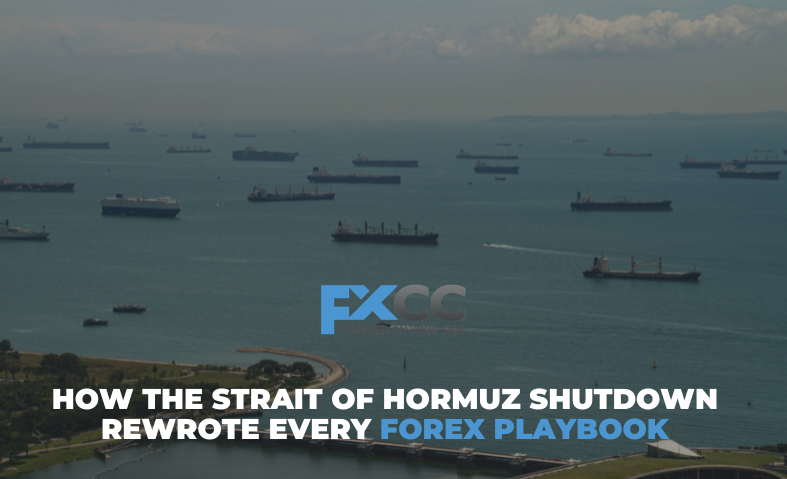
There is a strip of water roughly 21 miles wide sitting between Iran and Oman. It does not look like much on a map. But in March 2026, it became the single most important variable in every serious trader’s analysis — more influential than any Fed statement, any earnings report, or any central bank decision that year.
When Iranian forces declared the Strait of Hormuz closed on March 4, 2026, the ripple effects moved through forex markets so fast and in so many unexpected directions that strategies’ traders had used for years stopped working practically overnight.
This is the story of what actually happened — and what it means for how you trade from here.

The Playbook Everyone Was Running
Before the closure, most experienced forex traders were operating off a fairly clean macro thesis. The Federal Reserve was expected to cut rates. The dollar would soften. Emerging market currencies would get breathing room. Oil was stable. The trade was set up.
Energy-importing currencies like the Japanese yen and European pairs were positioned with that rate-cut expectation baked in. Gold was being bought as a hedge against eventual dollar softening. The correlations traders relied on — dollar down means commodities up, rates down means risk assets rally — all made sense.
Then the Strait closed, and none of it worked the way it was supposed to.
Rule 1 Broke First: Oil and the Dollar Stopped Inverting
The most reliable correlation in macro forex for decades has been the inverse relationship between oil prices and the US dollar. Oil goes up — dollar usually softens because the US economy faces higher input costs. That was the rule.
Brent Crude spiked above $100 per barrel immediately after the closure and peaked near $120. In the old playbook, that should have pressured the dollar.
Instead, the dollar held firm — and in some sessions, it strengthened.
The reason is critical for traders to understand. The United States is now one of the world’s largest energy producers and a major LNG exporter. When oil prices rise sharply, America’s terms of trade actually improve relative to energy-importing nations. The correlation that worked in 2008 and 2012 no longer applies in the same way in 2026.
Traders who were short the dollar based on the oil spike got stopped out because they were running a 15-year-old correlation in a fundamentally different energy landscape.
Rule 2 Broke Next: Safe Havens Didn’t All Move Together
The second shock was gold. When a major military conflict escalates and oil spikes, the textbook says gold goes up and stays up. Traders piled in hard above $5,400 per ounce in the immediate aftermath.
Then gold dropped.
The reason? The energy shock was so severe that it changed the inflation calculus completely. Elevated oil prices kept inflation sticky. Sticky inflation meant central banks — including the Fed — had to hold rates higher for longer, and talk of rate hikes came back onto the table. High real yields kill gold. Non-yielding assets lose their appeal when interest rates climb or stay elevated.
The trade that should have worked — buy gold during a geopolitical crisis — failed because the crisis itself changed the rate environment that determines gold’s value.
Meanwhile, the Swiss franc held up as a safe haven. USD/CHF told a much cleaner safe-haven story than gold did. Traders who spread their defensive positioning across both gold and the franc preserved more capital than those who concentrated entirely in gold.
Rule 3 Broke Quietly: Emerging Market Currencies Bled Out
This one was less dramatic but just as important. Asian and African emerging market currencies took the worst damage — and they did it quietly, without the headline drama of oil spiking or gold dropping.
Countries that import most of their oil — Bangladesh, Vietnam, parts of West Africa — faced a devastating combination: import costs soaring in local currency terms while the dollar they needed to pay for that oil was staying firm or strengthening. Their currencies weakened against the dollar while they were simultaneously forced to pay more for energy priced in those same dollars.
The carry trades into high-yielding emerging market currencies, which had been working well entering 2026, unwound fast. The risk-reward on those positions flipped from attractive to dangerous inside one week.
What the New Playbook Looks Like
The Hormuz closure did not create a new rule set as much as it forced traders to acknowledge something that had been building for years: old correlations need to be tested against new structural realities before being applied.
Here is what has changed going forward.
The dollar’s relationship with oil is no longer simply inverse. It depends on duration. A short spike might pressure the dollar. A prolonged supply disruption — one that keeps inflation elevated and forces central banks to stay hawkish — supports the dollar because it delays rate cuts everywhere.
Gold’s safe-haven status now has a condition attached to it: it works as a haven unless the geopolitical event itself changes the rate environment. If the crisis is inflationary, gold’s appeal shrinks at the same time fear drives buyers in. That contradiction needs to be priced into position sizing.
The pairs that tell the clearest story during an energy shock are the commodity-linked currencies — CAD, NOK, and AUD on the producer side versus JPY, EUR, and emerging market currencies on the importer side. Those spreads tell you more about the actual macro impact of the disruption than any single pair can.
Duration is everything. As one scenario analysis put it — the real driver is not where the oil price is today, it is how long the disruption lasts and how deep its effects run. A two-week spike is one trade. A six-month closure is a completely different regime.
The Trades That Actually Worked
In the weeks after March 4, the positions that performed were not the obvious ones. Long CAD against JPY captured the oil producer versus oil importer spread cleanly. Long USD/JPY worked because Japan’s intervention threats were not enough to offset the macro pressure from energy import costs. Short EUR/USD played the differential between the US energy position and Europe’s energy vulnerability.
The traders who made money were not the ones who called oil correctly. They were the ones who understood how oil’s move flowed through the rest of the currency map.
Bottom Line
The Strait of Hormuz closure in 2026 was not just an oil story. It was a live stress test of every correlation, every safe-haven thesis, and every macro assumption the forex market had been operating on. The traders who got hurt were the ones who ran old logic on a new situation. The traders who survived and profited were the ones who asked a different question — not “what does oil spiking usually mean?” but “given everything that has changed, what does this oil spike mean right now?” The playbook did not get thrown away. It got updated. And in this market, knowing the difference between the two is the only real edge that holds up.
Disclaimer:This article is for educational purposes only and does not constitute financial advice. Forex trading involves significant risk. Always trade responsibly.