When companies like Tesla or Nvidia release their earnings reports, the share price usually starts moving in one of two directions. Two very different trader profiles are watching that chart. One group is considering whether it’s finally cheap enough to buy and tuck away for a decade. The other group just wants to know where the price will be in the short term, and direction isn’t typically a major consideration.
The two groups are following the same stock, but they look at it from very different angles. Stock traders want ownership in the company. CFD traders want to profit from the share price, without any real preference if it goes up or down.
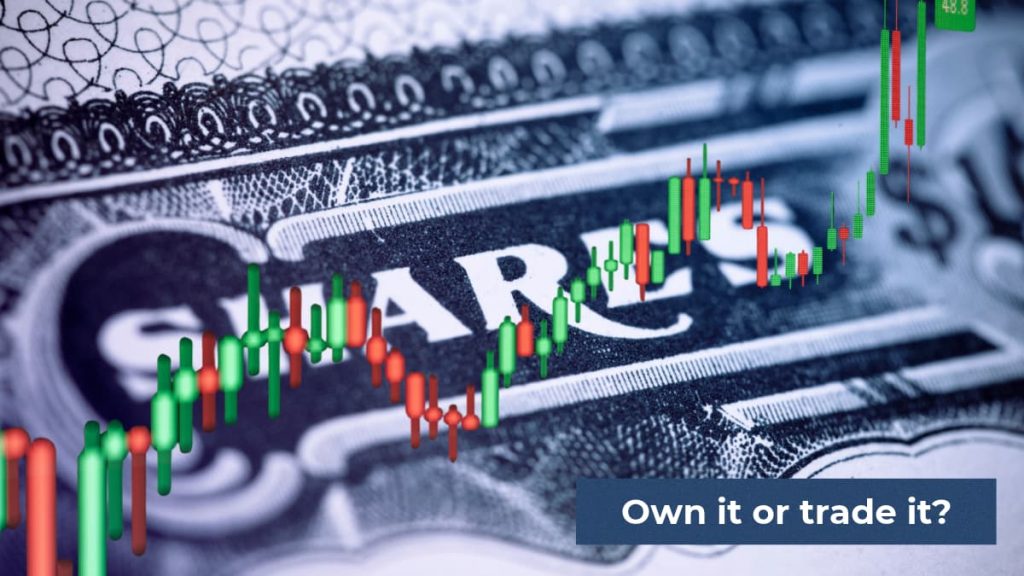
Stock traders invest in shares. CFD traders speculate on the movement. Their goal dictates how much money they need to commit and what happens when the share price starts falling.
Owning it vs trading its price
Buy a share, and you own a percentage of the company. Trade a stock CFD, and you’ve made a contract with your broker for the difference between the price when you open and the price when you close. CFD: Contract For Difference.
Owning shares entitles you to full rights, including dividend payments and voting rights in the case of ordinary shares.
That doesn’t hold for CFD traders. They don’t own any underlying shares, so they don’t get dividends or voting rights. What they do get is leverage and the option to trade short or long, according to their reading of the market.
Which one is the better option? Well, that depends on your investment goals, horizons, and, of course, risk appetite.
Buying shares
Go through a stockbroker, and you become a part-owner. Your shares are registered in your name or held by a nominee on your behalf, depending on the market and how the broker handles custody.
You get your dividends if and when the company issues any. Ordinary shares usually come with voting rights, and in an acquisition, you’ll get the proceeds your holding entitles you to.
Buying shares means you have to pay the full purchase price up front. Buying 100 shares at $100 each means putting down $10,000, before any commissions.
So let’s say results are poor and the stock drops 20%. Your stake is worth $8,000, leaving you $2,000 down on paper. Not great, but you still own the shares and could recover the loss.
Your broker won’t shred your share certificates just because the price dropped. You’ve paid full price for your shares, so there’s no margin call to worry about. You can hold on to them for as long as you like. There may be custody or account fees, however.
Trading stock CFDs
A CFD (contract for difference) is an agreement between you and your broker. You settle the difference between the share price when you open the trade and its price when you close it.
Your trade is the price difference, with profit or loss depending on how far the share price moves and whether or not it moves in the direction you traded.
You put down margin
The trade is leveraged, so you only need to deposit a fraction of the position’s value as margin. Your exposure covers the full amount, though. At 1:10 leverage, a $10,000 position means you have to put up $1,000 in initial margin. The CFD gives you exposure to the full $10,000 without taking out a conventional loan to buy the shares.
Falling prices become tradable.
Think the price will rise? Buy the CFD. Think the stock will tank? Sell first and buy back later when the price dips. You don’t need to borrow shares or arrange a separate securities lending facility.

Some brokers will let you short-sell physical shares, but you’ll need substantial credit facilities in place before that happens. Gordon Gekko may have managed it, but most retail share account holders won’t.
No shareholder rights
You don’t own any shares, so you don’t get voting rights or receive dividends. Instead, dividends and other corporate events are reflected as adjustments to your CFD account.
One trade, three outcomes
Take a stock currently trading at $100. A full position is for 100 shares. That means $10,000 of exposure if you buy the shares or trade a CFD. With the CFD, 1:10 leverage means you need $1,000 in initial margin. The examples below exclude trading costs.
| PRICE MOVE | SHARES ($10,000 INVESTED) | CFD LONG ($1,000 MARGIN) | CFD SHORT ($1,000 MARGIN) |
|---|---|---|---|
| $100 to $110 (+10%) | +$1,000 (10%) | +$1,000 (100%) | -$1,000 (-100%) |
| $100 to $90 (-10%) | -$1,000 (-10%) | -$1,000 (-100%) | +$1,000 (100%) |
| $100 to $80 (-20%) | -$2,000 (-20%) | -$2,000 (-200%) | +$2,000 (200%) |
Pay attention to the dollar figures for the stock purchase and the long CFD. They’re identical. What changes is how they compare with the cash put into the trade. A 10% move is a 10% gain or loss for the shareholder. For the CFD trader, it’s equivalent to 100% of the initial margin.
A relatively small move in the share price can wipe out the initial margin. If your account equity falls below the broker’s close-out level, one or more positions can be closed automatically.
What it costs to hold
The longer you keep a position open, the more costs matter.
When you buy shares, expect to pay commission or a spread when you trade. In rare instances, some brokers may waive commission fees. Depending on your broker, you might also be liable for custody, platform, or currency conversion fees. Once you’ve bought the shares, you generally won’t pay a daily charge to hold them.
CFDs have a spread. That’s the difference between the buying and selling prices. Some brokers also charge commission. With FXCC, there are no commissions, so that’s an automatic benefit right off the bat!
Trade CFDs and overnight financing will become a factor. Keep a position open past your broker’s daily cut-off, and swaps (the overnight financing charges) will start to kick in.
For a few hours or a couple of days max, swaps won’t be a big deal. For long-term positions, though, charges start to inch up. That’s one os the reasons CFDs suit shorter-term trading, while buying shares outright is generally a better fit for longer holding periods.
Dividends and Splits
Whenever a company issues a dividend, shareholders will receive that directly. CFD traders, on the other hand, get a cash adjustment. That’s usually a credit on a long position and a debit on a short one.
That credit (or debit) amount won’t always be the same monetary value as the shareholder dividend. Your broker will account for withholding tax, which affects the calculations.
Stock splits and special dividends also lead to adjustments to open CFD positions. These reflect changes to the underlying shares, so your position’s value is adjusted accordingly. You get the financial benefit or cost, but no voting rights or say at the AGM.
A side-by-side comparison
| FEATURE | BUYING SHARES | STOCK CFDs |
|---|---|---|
| What you own | Part of the company | A contract based on the share price |
| Money needed up front | Full purchase price | A fraction of the position value as margin |
| Leverage | Not normally involved when buying outright | Available |
| Trading falling prices | Requires a short-selling facility | Sell first and buy back later |
| Dividends | Paid to shareholders | Cash adjustment to the trading account |
| Voting rights | Usually, on ordinary shares | None |
| Holding costs | Usually no overnight financing | Overnight financing may apply |
| Effect of price moves | In line with the amount invested | Magnified relative to initial margin |
| Holding period | Suits long-term ownership | Often used for shorter-term trading |
So which one’s for you?
The decision boils down to the time factor in particular. Are you building a long-term portfolio or are you looking to capitalize on short-term price fluctuations?
Long-term player?
If your investment window looks out to the next five or ten years, then investing in physical shares in a particular company makes more sense. You own a piece of it and can ride out the bad quarters without daily financing eating into the position.
Provided you’ve paid for the shares in full, a price drop won’t trigger a margin close-out.
Thinking in hours, days or weeks?
CFDs are a useful option when you want to trade shorter-term moves in a share price. You can opt to go long or short without paying the full value of the position. Some traders, for example, open positions ahead of earnings announcements or company news, hoping to profit from the market’s reaction.
Leverage is a double-edged sword. It can increase your gains, but it can also magnify losses. And if you leave a CFD open overnight, financing charges can add up.
You don’t have to choose one approach and stick with it. Some investors hold shares for the long term and trade CFDs on the same companies separately. Others use CFDs to trade stocks they wouldn’t necessarily want in their investment portfolio.
When the news hits
Share prices can become highly volatile when earnings come out. Investors look at the numbers, but they’re also listening to what management says about the months ahead. That’s one reason traders follow earnings reports so closely.
But company results aren’t the only thing that can send share prices into a spin. News affecting an entire sector can drag stocks down together. The AI sell-off following the US midterms was a good example.
Companies can post strong earnings numbers and still see their shares fall. If investor expectations were higher than the actual results, share prices can suffer.
It all boils down to forecasts and expectations. If investors are expecting a number, anything that falls below that can trigger price drops.
Some traders will take a position before earnings are released. They’ve done their research and have their strategy locked in. Other traders will wait to see how the wider investing public reacts before deciding which way to go. Both approaches carry risk. A stock can move sharply after an announcement and sometimes can open well above or below its previous close.
With a stock CFD, the only variable is the share price movement. You don’t need to buy physical shares in the company.
You only need the initial margin, not the full value of the position.
FXCC offers stock CFDs on major US companies, including Tesla and Nvidia, and you can trade them alongside forex, indices, and commodities.
CFDs are complex instruments and carry a high risk of rapid losses due to margin trading. Consider whether you understand how CFDs work and whether you can afford the risk of losing your money. This article is for educational purposes and is not investment advice.