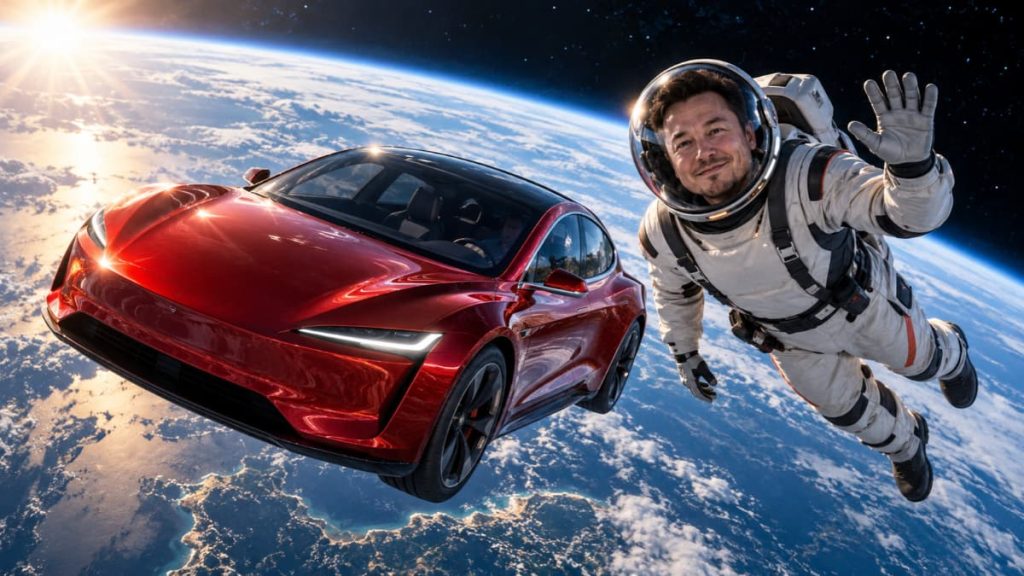
Elon Musk had sidestepped questions about a possible Tesla-SpaceX merger for months. He confirmed the talks on October 20, 2026, during SpaceX’s third-quarter earnings call.
There is no deal done yet. But if one happens, the combined entity could be worth more than $3.5 trillion. The value comes from valuation studies by RBC and Barclays: RBC estimates the combined value at $3.74 trillion, and Barclays estimates it at around $3.6 trillion.
Tesla reports its Q3 results on 21 October, so the questions remain.
Tesla and SpaceX: Key merger figures
| METRIC | TESLA (TSLA) | SPACEX (SPCX) | POTENTIAL MERGER IMPLICATIONS |
|---|---|---|---|
| Latest Q3 results | 486,532 deliveries, down 2.1% YoY | $14.6B revenue, up 161% YoY | Combines an automotive and energy business with a rapidly growing space and AI business |
| Growth focus | FSD, robotaxis, Optimus and energy storage | Super Intelligence, Starlink and space infrastructure | Potential to connect AI software, computing and robotics |
| Musk’s ownership | Roughly 20% equity | Roughly 48% equity, over 82% voting power | Governance and control would be central to any deal |
| Illustrative valuation | Depends on the proposed exchange ratio | Depends on the proposed exchange ratio | RBC estimates $3.74T and Barclays around $3.6T for the combined company |
| Capital expenditure | Investment in vehicles, energy and robotics | $19.6B in Q3; Q4 forecast of $35B–$40B | Investors would need to assess the combined capital requirements and expected returns |
| Governance and approval | Independent special committee | Independent special committee | Musk says Tesla approval would require 50% of all outstanding shares |
Figures are based on information available as of 21 October 2026. Merger valuations are estimates, not agreed terms.
What Musk actually said
The committees are the news. Both boards have formed groups of independent directors to study a deal, and Musk is staying out of the room.
“Because I’m a conflicted party, I can’t actually be in the discussions,” he told analysts, adding that he thinks it would be a good idea.
He was also careful to cool things down. Musk said assuming a merger is certain would be overstating it. No terms have been agreed, and no regulatory filings have been reported. Still, according to a Reuters report, the talks began in recent weeks and could end with SpaceX acquiring Tesla.
This is a big step up from July. On Tesla’s Q2 call, Musk pointed to ‘more and more overlap’ between the two companies and said any deal would need ‘the appropriate process.’ Three months later, that process has now started.
Both stocks moved higher in after-hours trading on 20 October. SpaceX, which trades on Nasdaq under SPCX, rose about 8%, while Tesla gained around 1.8%. SpaceX’s earnings also helped drive the move. Revenue grew 161% year-on-year to $14.58 billion, net income reached $4.4 billion, and Adjusted EBITDA rose to $8.8 billion.
Watch: CNBC on the Tesla-SpaceX Merger Talks
The strategic case for a merger
Tesla and SpaceX already work together on a lot. Tesla supplies batteries and manufacturing technology for some SpaceX projects. The two are also building Terafab, a joint semiconductor plant for AI chips. Musk said it should produce its first test chip around May or June 2027 and reach volume production by Q3 2028. In July, he said Tesla would struggle to scale production of its Optimus humanoid robot without it.
SpaceX absorbed xAI in February in a deal valued at $1.25 trillion, bringing the Grok chatbot and Musk’s AI models into the company. SpaceX reported $14.58 billion in third-quarter revenue, up 161% year-on-year, driven by its Super Intelligence and Connectivity businesses.
The Super Intelligence segment generated around $7.56 billion in revenue. SpaceX said it added $6.7 billion in year-on-year revenue from Super Intelligence solutions and infrastructure, driven by cloud services agreements, the acquisition of Cursor, and growth in its models and software applications, including Grok Bot. Its nameplate computing capacity reached 1.7 gigawatts by the end of September.
Tesla, meanwhile, is betting heavily on robotaxis, autonomous driving and humanoid robots. Barclays analysts argue a merger would bring Tesla’s physical AI products together with SpaceX’s models, software and computing infrastructure. Musk listed AI software, chip design, robotics and connectivity among the areas of overlap, alongside Starmind, SpaceX’s planned orbital AI computing network, which would use Starlink to transmit data back to Earth.
The benefits don’t stop at combining technology. While Tesla would add car manufacturing and batteries, SpaceX would add satellite networking, AI models, and computation capabilities. A joint company could combine technology, manufacturing capabilities, and infrastructure across a range of fields. The challenge is making it work financially.
What Tesla shareholders would weigh
A merger can make industrial sense and still be a poor deal at the wrong price. For Tesla investors, the main concern is governance. Musk owns roughly 20% of Tesla, while SpaceX filings show his stake is just under half the company’s equity and his voting power is above 82%. In any deal, he’d effectively be on both sides of the table, which is why independent committees are running the talks.
The terms matter most. The exchange ratio would determine how many shares in the combined company Tesla investors receive for their existing holdings. In an all-stock deal, Tesla shareholders would exchange their shares for an interest in the combined business. So whether that’s a good deal depends on each company’s valuation and the ownership stake Tesla investors receive in return.
Analyst Dan Levy at Barclays suggests today’s valuation would give Musk 37% ownership of the new entity and 56% of the voting rights. RBC’s illustrative framework values the new entity at $3.74 trillion, with Tesla shareholders holding 48% of the shares.
Revenue generation from the expenditures is already considerable. SpaceX’s Q3 performance shows the extent of its expansion. Capital expenditures amounted to $19.6 billion, about three times the previous year, with $16.4 billion spent on AI computing capacity. The total capital expenditures will grow to between $35 billion and $40 billion in Q4.
The spending is already generating substantial revenue. SpaceX’s Super Intelligence segment reported $7.56 billion in Q3 revenue and $431 million in operating income. Excluding $1.2 billion in stock-based compensation linked to the Cursor acquisition, its operating profit was around $1.6 billion. That distinction matters when assessing the underlying performance of a business growing this quickly.
According to SpaceX, the company remains concerned about capital efficiency and ROIC as it grows. This will matter to Tesla investors. In terms of merger benefits, the company will gain a large revenue stream from its AI and connectivity business. However, it also needs to pay for its infrastructure, space ventures, manufacturing, power storage, and robotics.
Finally, the vote. Musk said a deal would need approval from 50% of all Tesla shares, not just those cast at the meeting, and called that ‘quite a high hurdle.’ The full approval process would depend on how any deal is structured.
What to watch next
- Tesla’s Q3 call, 21 October. Results are due after the US close, with the call at 5:30 PM Eastern. Tesla’s company-compiled analyst consensus, published on 19 October, puts average revenue expectations at $28.34 billion and non-GAAP earnings at $0.45 per share. Automotive gross margin, free cash flow, and management’s outlook will help investors assess the underlying business, independent of merger speculation.
- The annual meeting window. Barclays says a merger vote could fit into Tesla’s annual shareholder meeting, due no later than 6 December, but only if a deal is announced by late October or early November. With no terms agreed as of 20 October, that window is tight.
- Analyst odds. Gene Munster of Deepwater Asset Management has put the chance of a merger within two years at 95%, while Dan Ives puts it at 80% to 90% by the end of 2027. These are forecasts, not a deal timetable. Verify the latest statements and their timing before publication.
- Tesla’s core business. Q3 deliveries came in at 486,532 vehicles, down about 2.1% year over year. Deliveries are only part of the picture. So margins, cash generation, and the outlook for future demand will help determine whether Tesla’s underlying performance supports its valuation.
Trading Tesla around the merger story
Two catalysts are at work for Tesla: its Q3 numbers and the merger discussions. They do not necessarily have to be pointing in the same direction. Positive numbers can buoy the stock even if merger talks stall. On the other hand, positive merger discussions can buoy sentiment, while poor margins can drag the stock.
For CFD traders, the key question is how the merger could affect Tesla’s share price and market volatility. Understanding how the underlying market affects trading helps put those potential price movements into context.
Timing is important. Tesla’s price call comes when the United States market is already closed, so new information could be released even when the market is not open. The stock price could change even before the start of the following regular session.
With a CFD, you can speculate on Tesla’s share-price movements without owning the underlying shares. You can take a long or short position, depending on your market view. However, a merger remains uncertain, and earnings news can move the stock independently of any deal developments. Leverage magnifies both gains and losses, and sharp price movements can increase execution risk.
The FXCC ECN XL account supports Tesla CFDs on MT4 and MT5. Follow developments on our blog, and if they match your trading style, we’d be happy to have you join us!
CFDs are complex instruments and carry a high risk of rapid losses due to margin trading. Consider whether you understand how CFDs work and whether you can afford the risk of losing your money. This article is for educational purposes and is not investment advice.