
Friday’s NFP jobs report was supposed to settle whether the Federal Reserve will hike again in October. It came close. US employers added just 29,000 jobs in September, unemployment rose to 4.2%, and average hourly earnings rose just 0.1% on the month.
The October hike is now largely priced out. But markets’ reaction was far from a clean risk-on rally, and gold and oil show why.
In our preview, we mapped four scenarios. Friday delivered the scenario we said was most important to understand: soft jobs with oil still high. Brent finished the week back above $100, and with inflation risk, Treasury yields, and a firm dollar, gold couldn’t hold onto its early gains.
The numbers
The main headline figures came in weaker than expected, and the revisions made the picture even weaker.
| INDICATOR | SEPTEMBER ACTUAL | FORECAST | AUGUST |
|---|---|---|---|
| Nonfarm payrolls | +29,000 | +84,000 | +133,000 (revised from +162,000) |
| Unemployment rate | 4.2% | 4.1% | 4.1% |
| Average hourly earnings (monthly change) | +0.1% | +0.3% | +0.3% |
| Average hourly earnings (annual change) | +3.0% | +3.1% | +3.1% |
Forecasts: MarketWatch economist survey.
The revisions mattered too. August’s job gain was revised down to 133,000 from 162,000. July was revised even more sharply, from a gain of 21,000 to a loss of 10,000. Taken together, the two months produced 60,000 fewer jobs than originally reported. We flagged the August revision as a number to watch in our preview. It became one of the clearest signs that the labor market was weaker than the headline suggested.
Wages answered the question we asked. The preview said a monthly earnings reading of 0.2% or below would support the view that the oil shock is still contained to energy prices. September came in at 0.1%, with pay at $37.81 an hour. There’s still little evidence of workers pushing higher energy costs into wages, the second-round effect the Fed has been watching for.
Not everything was weak. Participation rose to 61.8%, suggesting part of the rise in unemployment reflects more people looking for work rather than layoffs. Health care added 17,000 jobs and construction 11,000, while financial activities lost 7,000.
The Fed: October fades, December stays
At the start of last week, an October hike still looked fairly likely, with CME FedWatch putting the odds at around 75%. By Wednesday, those odds had dropped to about 35% following softer data and dovish comments from the Fed. Friday’s jobs report pushed them down again, to roughly 20% to 25%.
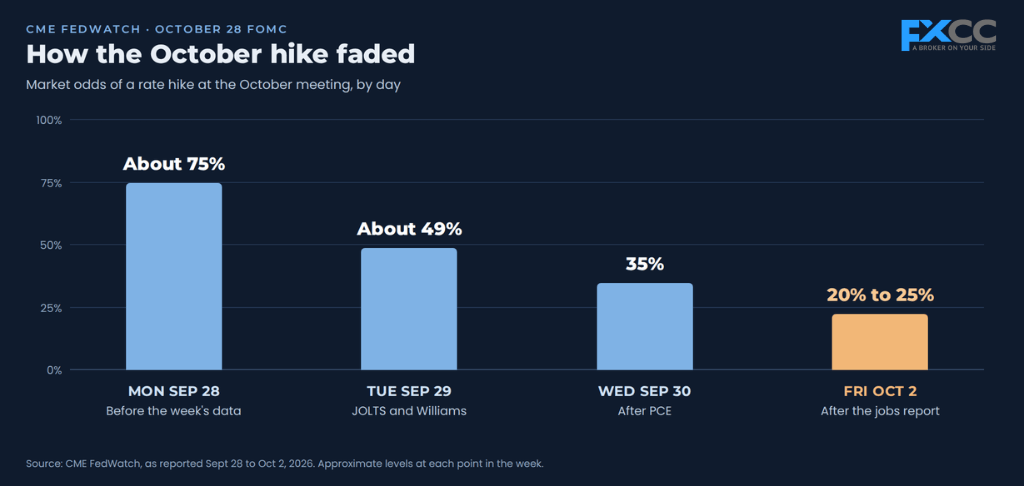
That doesn’t mean the hiking cycle is over. Markets read the weak jobs data as a reason to delay tighter policy, not abandon it, and December remains the more likely meeting for another hike. JPMorgan economist Michael Feroli summed up the view, as quoted by Bloomberg: “It would now take a very strong CPI to make the October meeting live. We continue to look for another hike at the December FOMC meeting.”
That’s stagflationary pressure in practice. A weaker labor market takes pressure off the Fed in the short term. But with oil still above $100, inflation risk hasn’t gone away, keeping another hike in December on the table.
The next test comes quickly:
| DATE AND TIME (ET/GMT) | EVENT |
|---|---|
| Wed Oct 14, 8:30 AM / 12:30 | Consumer Price Index (CPI), September |
| Thu Oct 15, 8:30 AM / 12:30 | Producer Price Index (PPI), September |
| Wed Oct 28, 2:00 PM / 18:00 | Fed rate decision (FOMC) |
Gold: why weak jobs didn’t spark a rally
Gold initially moved higher after Friday’s jobs report, but the rally didn’t last. The weaker payroll number and softer wage growth pointed to less pressure from the Fed, yet spot gold ended Friday near $4,142, down about 0.8% on the day and more than 3% for the week, according to Kitco.
The reason is yields. Lower odds of an October hike would normally pull Treasury yields down; this time they didn’t. The 10-year yield fell briefly after the report, then closed higher at 5.28%, with the 30-year at 5.63%, according to Treasury data. Even the 2-year yield, the most sensitive to Fed expectations, finished the day higher.
That’s because markets only moved the next hike back, not off the table. They largely priced out October but kept December in play, and with oil still above $100, investors continue to see inflation risk further out. With yields still that high, the usual boost from weaker jobs data wasn’t enough to keep gold higher.
As of Monday, gold was down nearly 6% over the past month and well below the record it set in late January.
Levels traders are watching, as cited in Kitco’s coverage:
| LEVEL | WHY IT MATTERS |
|---|---|
| $4,280 | 100-day moving average, the first major resistance |
| $4,200 | Near-term pivot. Failure to close above it keeps pressure on |
| $4,100 | Next downside reference if $4,200 holds as a ceiling |
| $4,000 | Key support band, where several analysts expect consolidation |
Views are split. Trade Nation’s David Morrison thinks gold hasn’t bottomed yet and expects consolidation around $4,000 before any renewed rally.
What to watch: The October 14 CPI report may tell us more about where gold goes next. If inflation comes in soft and yields fall, the metal could recover. A hotter number would make that much harder.
Energies: oil holds above $100 despite the G7
Oil was the reason Friday’s weak jobs data didn’t play out as a simple dovish story. Brent fell below $100 midweek, then finished Friday near $101, with WTI around $91.
The G7 reserve release. On Friday, the G7 agreed to release up to 100 million barrels from emergency stocks over four months, initially focusing on diesel, Bloomberg reported. The US national average for diesel passed $6 a gallon for the first time in September, and European diesel futures have traded above $200 a barrel. Diesel prices reacted more strongly than crude. Europe’s diesel premium over crude fell to about $69 a barrel from nearly $77, while Brent dipped and then recovered.
The release is smaller than the headline suggests. Much of the 100 million barrels was pledged back in March and hasn’t been delivered yet. And OPEC+ kept its production quotas unchanged.
Hormuz remains the key wildcard. US-Iran talks have made limited progress, and attacks on shipping in and around the Gulf keep a risk premium in crude prices. At the same time, Persian Gulf exports have largely recovered through alternative routes, which limits the immediate supply shock.
The Brent-WTI gap of around $10 a barrel also stands out. It reflects how differently the two benchmarks are exposed: Brent prices, seaborne crude caught up in the Middle East disruption, while WTI is tied more closely to US supply.
Natural gas has gone the other way. US prices fell more than 6% last week to about $3.00 per MMBtu on record production and mild weather, suggesting US gas is driven by domestic supply, not the Middle East.
What to watch: The US-Iran talks and the G7 diesel release are the main things to follow over the next few weeks. Brent is the other key marker. If it stays above $100, oil will keep fueling inflation concerns. A move below that level would ease some pressure and could lift gold.
Bonds, the dollar and stocks
Bonds. Treasury yields initially fell after the jobs report, but the move didn’t last. Yields finished higher across the curve, with the 30-year still close to its highest level since 2002. Oil prices above $100 kept inflation concerns from fading.
The dollar. The dollar slipped on Friday but held onto weekly gains, supported by high US yields.
Equities. Stocks welcomed the lower risk of an October hike. On Friday, the S&P 500 rose 0.73%, the Nasdaq 1.19% and the Dow 0.49%. If long-term yields keep climbing, though, valuations come under pressure.
The bottom line
Friday’s report largely settled the question of an October hike. The 29,000 jobs added in September, the downward revisions and the 0.1% rise in wages have pushed the odds of an October move sharply lower. For now, December looks like the more likely time for another hike, with Brent above $100 and the 30-year Treasury yield near its highest level since 2002.
Gold still needs lower yields before the weak jobs report can really help it. A softer CPI reading would give it some room to recover. A breakthrough on Hormuz could have a similar effect. The G7 release adds supply to the oil market, but events around Hormuz are still having the bigger influence on prices.
The September CPI report on Wednesday, October 14, will be the next major test. A softer inflation reading would give gold some room to recover and make an October hike even less likely. A hotter number would shift attention back to December.
CFDs are complex instruments and carry a high risk of rapid losses due to margin trading. Consider whether you understand how CFDs work and whether you can afford the risk of losing your money. This article is for educational purposes and is not investment advice.