
Brent crude oil rose back above $101 a barrel in Asian trading on Wednesday, October 7, with WTI just above $90. Reuters linked the gains to Houthi attacks on Saudi Arabia and a storm in the Gulf of Mexico forecast to become the first Atlantic hurricane of 2026.
The move occurs as Gulf exports are recovering, and Saudi Arabia’s main export route that bypasses the Strait of Hormuz has been attacked twice in less than a month. The market isn’t asking whether Saudi Arabia can export oil. It’s asking whether it can rely on that route if the attacks continue.
Gulf supply is recovering.
Gulf crude oil, condensate and fuel exports, excluding Iran, averaged about 19.2 million barrels a day in September, according to Vortexa data Reuters reported. Before the Iran war began on February 28, they ran at about 23.6 million barrels a day. September’s flows were more than 81% of that.
September crude and condensate flows had recovered to roughly 91% of the pre-war level. Refined fuel exports were still only around 60%. Diesel prices have remained high as a result, despite the recovery in crude shipments.
Saudi Arabia did most of the work. Kpler data showed its crude shipments rose to about 6.6 million barrels a day in September. Much of that oil now goes west through the East-West pipeline to the Red Sea port of Yanbu, avoiding Hormuz.
Saudi Arabia’s alternative export route comes under attack.
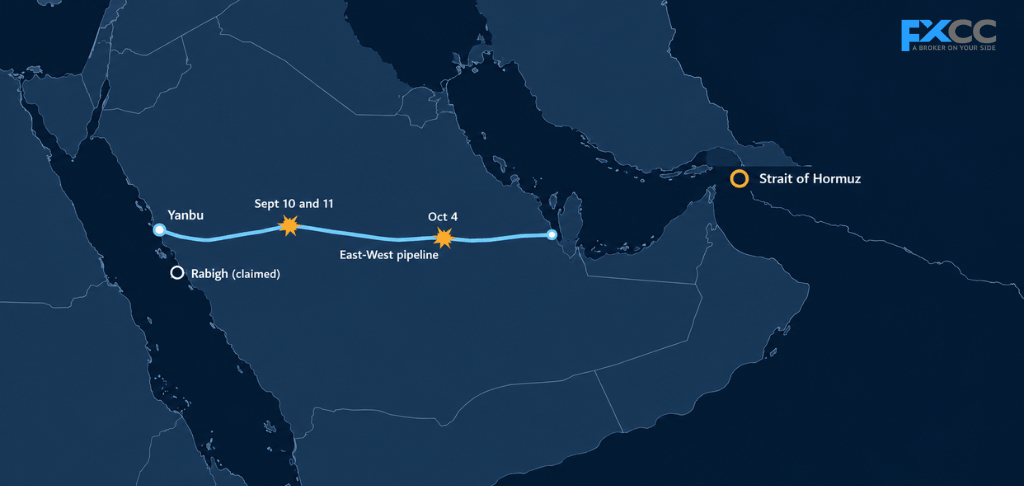
The East-West pipeline lets Saudi Arabia move oil to the Red Sea without using the Strait of Hormuz. That makes it central to the recovery. It has now been hit twice, in separate incidents blamed on different groups:
| DATE | WHAT HAPPENED |
|---|---|
| Sept 10 and 11 | Drone strikes damaged pumping stations and flows stopped. Saudi officials attributed the attack to Iraq-based actors. |
| Around Sept 22 | Flows resumed at a reduced rate, with Yanbu loadings set to restart the next day. |
| Oct 4 | In a separate incident, the Houthis claimed a strike on a pumping station near Khurais. An energy sector source told Reuters the pipeline stopped again. |
| Oct 6 | Energy Minister Prince Abdulaziz bin Salman said flows were back at 5.8 million barrels a day, against capacity of about 7 million. |
The quick restart has helped limit fears of a prolonged disruption. But the repeated attacks have made it harder for the market to price the supply recovery as secure.
Houthi escalation widens the risk to crude oil.
The pipeline strike came as fighting between Saudi Arabia and Yemen’s Iran-backed Houthis escalated. On Monday, attacks hit Jazan and Najran airports in southern Saudi Arabia, the Saudi aviation authority confirmed. The Houthis also claimed strikes on Riyadh’s main airport and on the Aramco refinery at Rabigh. Saudi Arabia hasn’t confirmed either.
Rabigh is particularly relevant to the crude oil market. It sits on the Red Sea coast, and the Red Sea is the route Saudi Arabia is using to move oil around the Strait of Hormuz. Even without confirmed damage, Reuters reported that higher freight and insurance costs and shipping risks are keeping crude elevated. Mukesh Sahdev of X Analysts expects prices to hold near $100 “without any material de-escalation.”
The hurricane adds a separate US risk.
A tropical system in the Gulf of Mexico is expected to become Tropical Storm Isaias and reach hurricane strength by Thursday. The National Hurricane Center expects landfall on Friday night between southeastern Louisiana and the Florida Panhandle. It would mark an unusually late start to the Atlantic hurricane season.
The potential exposure is large, but the actual result depends on the track. Offshore fields in the projected path produce about 15% of US crude oil and 5% of its natural gas, and six refineries could be affected, Reuters reported. But current forecasts take the storm east of the main offshore production areas south of Louisiana and Texas, Bloomberg noted. A shift west would change that.
Watch for platform evacuations, production shut-ins and refinery closures over the next 48 hours. They typically begin before anyone knows of physical damage.
What it means for inflation, the Fed and gold
These are second-order effects, but they matter for other markets. Weak jobs data last week reduced the case for a near-term Fed hike. Sustained high oil prices work the other way: they make it harder for inflation to fall quickly, which complicates the outlook for future policy.
The September CPI report on Wednesday, October 14, will show inflation before this week’s oil move. October’s figures, due in November, will be the first to show any effect.
Gold’s recent price action suggests rate expectations and Treasury yields still outweigh geopolitical risk. After the September jobs report on October 2, gold fell even as October hike odds dropped, because Treasury yields closed higher. If higher oil keeps yields up, that pattern could continue.
What to watch
| DATE | EVENT |
|---|---|
| Thu Oct 8 to Sat Oct 10 | Storm track and strength, offshore evacuations, production shut-ins and refinery closures |
| Ongoing | East-West pipeline flows and any confirmed damage to Saudi energy infrastructure on the Red Sea coast |
| Wed Oct 14, 8:30 AM ET (12:30 GMT) | US CPI for September |
| Wed Oct 28, 2:00 PM ET (18:00 GMT) | Fed rate decision |
The bottom line
Gulf supply is recovering, and over time that should weigh on crude. The problem is that traders are no longer looking only at how much oil is being produced. They’re also asking whether it can keep reaching the market safely. Until the attacks on Saudi Arabia’s alternative export routes ease, the risk premium is likely to remain elevated.
CFDs are complex instruments and carry a high risk of rapid losses due to margin trading. Consider whether you understand how CFDs work and whether you can afford the risk of losing your money. This article is for educational purposes and is not investment advice.