

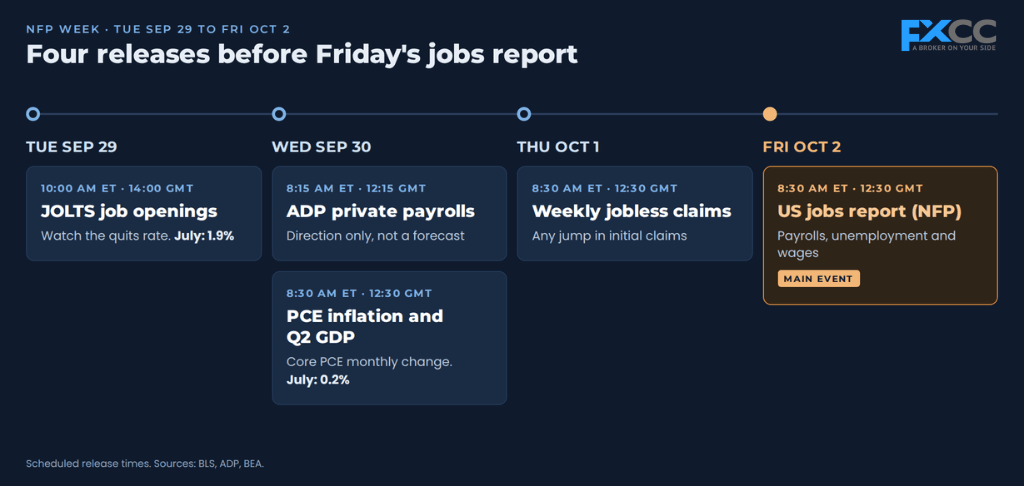
Friday’s US jobs report is the main event this week, but it won’t arrive cold. Four releases land first, and each one tests a different part of the story traders will be reading on Friday.
JOLTS shows how much demand for workers is left. ADP gives an early, if unreliable, read on private hiring. Wednesday’s PCE report is the Federal Reserve’s preferred inflation gauge and lands two days before payrolls. Thursday’s jobless claims are the last labor-market signal before the main event.
The Fed raised rates on September 16, and oil is above $100. This week, the question is whether incoming data strengthens or weakens the case for another hike on October 28.
Tuesday: JOLTS job openings (August)
10:00 AM ET (14:00 GMT)
The Job Openings and Labor Turnover Survey counts how many jobs employers are trying to fill, and how many people are hired, quit, or laid off. It runs a month behind the US jobs report, so Tuesday’s release covers August.
For a baseline, here is the previous release. In July, openings stood at 7.3 million, a 4.4% rate. Hires were 5.1 million and layoffs 1.7 million.
This week, the number we’d watch most closely is quits. In July, only 3.1 million people left their jobs voluntarily, a quits rate of 1.9%. Tuesday’s August figure is the one to compare against it. People tend to quit more readily when they feel confident they can find another job, often one that pays more. A low quits rate can point to weaker wage pressure, particularly if the decline persists.
That links straight to Friday. The bigger question for the Fed is whether higher energy costs are feeding into broader inflation, including pay. If quits stay near 1.9%, that would suggest workers aren’t gaining much additional bargaining power to push wages higher. A clear rise would suggest they’re starting to.
Wednesday: ADP private payrolls (September)
8:15 AM ET (12:15 GMT)
ADP’s report comes from payroll data from companies that use its services, and it lands two days before the official count. That makes it the first major September hiring figure. It’s also a poor predictor of the official figure.
August was a good example. ADP reported just 38,000 private-sector jobs, its slowest pace since January. Two days later, the government’s count put private-sector hiring at 127,000, within a 162,000 headline total. Anyone using ADP as a preview would have got the wrong picture.
Wednesday’s number is a mood indicator, not a forecast. A very weak or very strong ADP print can move the dollar briefly, but those moves can change come NFP Friday, October 1st.
Wednesday: PCE inflation (August) and revised GDP
8:30 AM ET (12:30 GMT)
Of the four releases, PCE is most directly tied to the Fed’s inflation target. The personal consumption expenditures (PCE) price index is the measure the Fed uses to define its 2% inflation goal, and it covers a broader basket of spending than CPI.
In July, PCE prices rose 0.2% on the month and 3.7% on the year. Core PCE, which strips out food and energy, also rose 0.2%, putting it 3.3% higher than a year earlier.
August CPI has already come out, so the market has a head start. Headline CPI rose 0.4% and core CPI 0.3%, both firmer than July. The question on Wednesday is whether PCE confirms that pickup. A monthly core PCE reading of 0.3% or higher would keep inflation concerns front and center ahead of payrolls. That would make Friday’s wage figure even more important for the October decision.
Another wrinkle is Wednesday’s release. The Commerce Department begins its annual update of the national accounts the same day, which can revise earlier months.
Governor Christopher Waller also said in remarks on September 3 that a pending change in how stock-trading fees are estimated could lower 12-month PCE inflation by a few tenths of a percentage point. If that change appears in this release, the annual figure could fall without signaling a real improvement in underlying inflation. Check the monthly figures before concluding.
The third estimate of second-quarter GDP is also released at the same time, although the inflation data is likely to get more attention ahead of Friday’s payrolls.
Thursday: Weekly jobless claims
8:30 AM ET (12:30 GMT)
Claims are the last labor-market signal before Friday. One week’s number rarely changes the picture on its own, but a sudden rise in initial claims would be worth noting alongside JOLTS and ADP.
The week at a glance
| DATE AND TIME (US EASTERN TIME) | RELEASE | WHAT TO WATCH |
|---|---|---|
| Tue Sep 29, 10:00 AM | JOLTS job openings, August | Quits rate (July: 1.9%) |
| Wed Sep 30, 8:15 AM | ADP private payrolls, September | Direction only, not a forecast |
| Wed Sep 30, 8:30 AM | PCE inflation, August, and Q2 GDP | Core PCE monthly change (July: 0.2%) |
| Thu Oct 1, 8:30 AM | Weekly jobless claims | Any jump in initial claims |
| Fri Oct 2, 8:30 AM | US jobs report, September | Payrolls, unemployment and wages |
What it means for the US Jobs Report
None of these releases settles the Fed’s October decision on its own. Together, they shape how traders read the US jobs report.
A firm PCE print and a steady quits rate would put even more weight on Friday’s wage figure. If wages also run hot, the pressure on the Fed to raise rates again would build. If PCE softens, even a strong jobs number may carry less inflationary weight, which could change how the dollar, Treasury yields, and gold react on Friday.
Our full September NFP preview, with the consensus forecast, four scenarios, and the instruments to watch, is published on Thursday, October 1.
CFDs are complex instruments and carry a high risk of rapid losses due to margin trading. Consider whether you understand how CFDs work and whether you can afford the risk of losing your money. This article is for educational purposes and is not investment advice.