
The US jobs report for September lands on Friday, October 2, at 8:30 AM ET. It arrives at an awkward moment for the Federal Reserve.
Two weeks earlier, the Fed raised rates for the first time since July 2023, lifting the federal funds rate range to 3.75% to 4.00% in a unanimous 12-0 vote. The question now is whether it goes again.
Markets currently price about a 35% chance of another quarter-point hike on October 28, according to CME FedWatch, down from about 70% a week ago. Friday’s report could firm up that bet or weaken it. Put simply: does the labor market give the Fed cover to hike again, or a reason to wait?
Behind all of this sits oil. Brent crude trades near $98 a barrel, pushed higher by the Iran conflict and restrictions on shipping through the Strait of Hormuz.
That makes this jobs report especially important. Energy is pushing headline inflation higher, and the Fed will watch whether those higher costs are feeding through into wages.
When the report lands
| CITY | LOCAL TIME, FRIDAY OCT 2 |
|---|---|
| New York | 8:30 AM |
| London | 1:30 PM |
| Frankfurt | 2:30 PM |
| Dubai | 4:30 PM |
| Singapore | 8:30 PM |
That’s 12:30 GMT. Liquidity often thins in the minutes before the release, and spreads can widen around it.
Why this jobs report matters more than usual
The September hike came with a clear signal about what’s next. In the Fed’s updated projections, 16 of 18 officials expected at least one more rate hike this year, and four saw room for two.
Since that meeting, the signals have been mixed. S&P Global’s September survey showed US private-sector activity growing at its fastest pace in more than five years, and the 10-year Treasury yield is at 5.24%. But Wednesday’s PCE report, the Fed’s preferred inflation gauge, came in softer than expected. Core prices rose 0.2% in August and 3.0% on the year, below the 3.3% forecast. As we noted in our look at this week’s data, the annual figure also reflects revisions to earlier months, so the monthly number is the cleaner signal.
Even so, rate cuts aren’t part of the conversation right now. A soft number on Friday is more likely to push the next hike from October to December than to revive talk of easing.
The road to October 28
Friday is the first of two big tests before the Fed meets, not the final word.
| DATE AND TIME (US EASTERN TIME) | RELEASE |
|---|---|
| Fri Oct 2, 8:30 AM | Employment Situation (September) |
| Wed Oct 14, 8:30 AM | CPI and Real Earnings (September) |
| Thu Oct 15, 8:30 AM | PPI (September) |
| Wed Oct 28, 2:00 PM | FOMC rate decision |
The September CPI report on October 14 is the last CPI report before the decision. A strong jobs report followed by a soft CPI print, or the reverse, could swing October pricing twice in two weeks.
What August told us
August’s numbers were a clear step up from the weaker summer reports. Payrolls increased by 162,000, the most in five months, compared with about 53,000 expected. Unemployment stayed at 4.1%. Meanwhile, the participation rate rose from 61.4% to 61.6%.
Revisions helped too. June and July were revised up by a combined 55,000, with July swinging from a loss of 23,000 to a gain of 21,000. That lifted the three-month average to about 71,000 a month.
Wages were steadier. Average hourly earnings rose 0.3% to $37.75, putting annual growth at 3.1%.
Tuesday’s JOLTS report pointed the same way: the quits rate held at 1.9% in August, so there’s still little sign of workers pushing hard for higher pay.
What the market expects for September
| INDICATOR | SEPTEMBER FORECAST (CONSENSUS) | AUGUST RESULT |
|---|---|---|
| Nonfarm payrolls | +84,000 | +162,000 |
| Unemployment rate | 4.1% | 4.1% |
| Average hourly earnings (m/m) | +0.3% | +0.3% |
| Average hourly earnings (y/y) | +3.1% | +3.1% |
Consensus: MarketWatch economist survey, as of Sept 30.
Reading the noise
A single payrolls number is less precise than the headlines suggest. Keep these in mind before reacting to the first print:
- The margin of error is wide. The BLS says a monthly payroll change needs to be about 122,000 to be statistically significant. A 40,000 miss against consensus sits inside normal survey noise.
- August gets revised on Friday. If the 162,000 is marked down sharply, that could matter as much as the September headline. CNBC noted before the August release that the initial August count had been revised lower four years running.
- Bigger revisions are already in the pipeline. The BLS’s preliminary benchmark revision cut March 2026 payrolls by 79,000.
Wages: the number to watch
In most months, traders focus on the headline payrolls figure. This month, average hourly earnings deserve at least as much attention.
Consumer prices rose 0.4% in August while wages rose 0.3%, so real average hourly earnings fell 0.1%, according to the BLS. Headline inflation is running at 3.4% a year, with gasoline up 27.4%. Pay is trailing prices, not pushing them. Core CPI, which strips out food and energy, rose 0.3% in the month but slowed to 2.4% annually.
That gap has been part of the case for patience. In remarks on September 3, before the hike, Governor Christopher Waller said that once productivity is taken into account, wage growth is broadly consistent with inflation coming down to 2%. In the same remarks, he said he’d consider a hike if August inflation came in hot. Core CPI then beat forecasts, and the Fed hiked two weeks later.
So the wage argument hasn’t been tested since the hike. A September reading of 0.4% or more would test it. It would suggest workers are starting to recoup energy costs through higher pay, the kind of second-round effect that can turn a temporary oil shock into more lasting inflation. A reading of 0.2% or below would support the view that the oil shock is still contained to energy prices.
Four scenarios for Friday
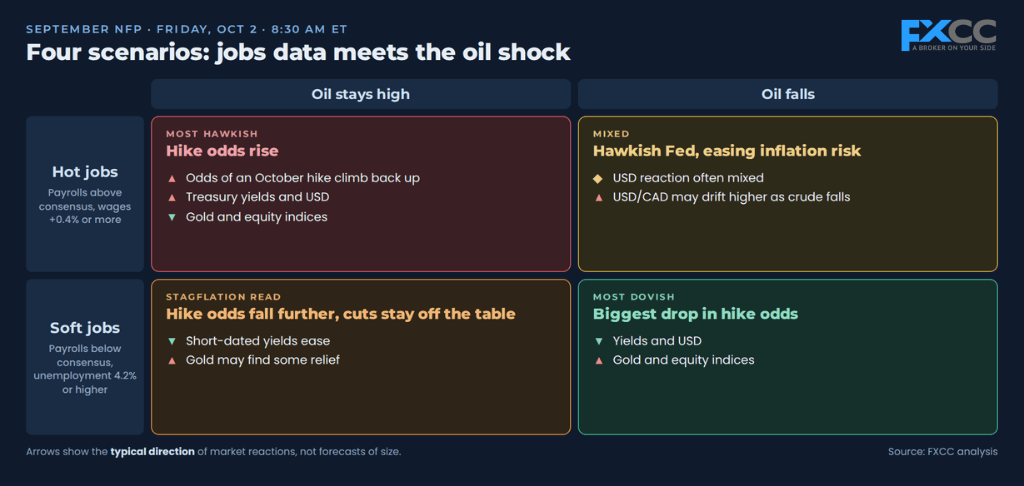
The jobs report won’t be the only thing moving markets. Oil isn’t released at 8:30 AM, but its price will still matter, and US-Iran headlines could send crude sharply higher or lower around the report. The table below looks at the jobs outcome under two oil scenarios: crude staying high, or falling back, if there is progress toward reopening the Strait of Hormuz.
For this purpose, a hot report means payrolls above consensus, with average hourly earnings rising 0.4% or more. A soft report means payrolls below consensus, with unemployment at 4.2% or higher. These labels reflect the direction markets might move, not how far.
| OIL STAYS HIGH | OIL FALLS | |
|---|---|---|
| Hot jobs | Hike odds rise. An October hike comes back into play. Treasury yields and the dollar typically firm, while gold and equity indices tend to come under pressure from higher discount rates. | Hawkish Fed, easing inflation risk. The dollar’s reaction is often mixed. USD/CAD may drift higher as crude falls. |
| Soft jobs | Stagflation read. October hike odds fall further, but cuts stay off the table. Short-dated yields tend to ease, and gold may find some relief. | Most dovish combination. The biggest drop in October hike odds. Yields and the dollar typically soften, while gold and equity indices tend to benefit. |
Weak jobs don’t automatically mean a dovish Fed. When oil is pushing inflation higher, a softer labor market doesn’t give the Fed a clean reason to ease. It leaves policymakers caught between slowing growth and rising prices, which is why the soft-jobs, high-oil box reads as stagflation rather than relief. That tension may be the most important thing to understand about Friday’s release.
Mixed reports are common. Strong payrolls with soft wages, or weak hiring with hot wages, tend to produce choppier moves as traders decide which part of the report matters more. Given the Fed’s focus on inflation, wages may carry extra weight this time.
Instruments to watch
EUR/USD
The Fed isn’t the only central bank tightening into the oil shock. The ECB raised its deposit rate to 2.50% on September 10, so the rate story isn’t one-sided. Friday’s reaction is likely to run mainly through the dollar leg. In the background, higher energy costs weigh more heavily on euro-area industry than on the US economy.
USD/JPY
The yen has been weak, and the pair was trading near 159 in late September, close to the 160 level that markets watch for official action. Reports of a Bank of Japan rate check have kept intervention risk in focus. After a hot print, that risk can cap sharp upside moves, and any intervention could quickly reverse a dollar rally.
USD/CAD
This pair hasn’t followed the usual oil story. Canada is a major oil exporter, so higher crude would normally help the loonie. But with Brent near $100, USD/CAD was around 1.41 in late September and moved higher during the week. Other factors have mattered more, including the breakdown in Canada-US trade talks, higher tariffs, and the widening rate gap after the Fed hiked while the Bank of Canada held. On Friday, the question is whether the pair reacts more to the US data, crude, or both.
Gold
Gold fell about 5% over the past month as Treasury yields moved higher. For now, rates are influencing gold more than its usual role as a hedge against war. Gold doesn’t pay interest, so higher yields make it less attractive to hold. A stronger jobs report could add to the selling pressure. A weaker report could ease some of that pressure.
Equity indices
For stocks, interest rates matter because they affect today’s value of future earnings. As yields go up, that tends to put more pressure on expensive growth stocks. Strong business surveys can still point to better earnings, but in a hiking cycle, stronger-than-expected data can hurt equities if it pushes yields higher.
The bottom line
Friday’s report matters because the Fed has already shown it will act. With oil near $100 and business surveys running hot, the case for another hike is still alive. But softer PCE data has made a pause a real possibility, and Friday’s wage figure could tip the balance.
Watch the wage figure, not just the headline, and check the August revision before reading too much into September. Keep October 14 in mind. That’s when the next CPI report comes out. It could reinforce what Friday’s data showed. It could also tell a different story.